
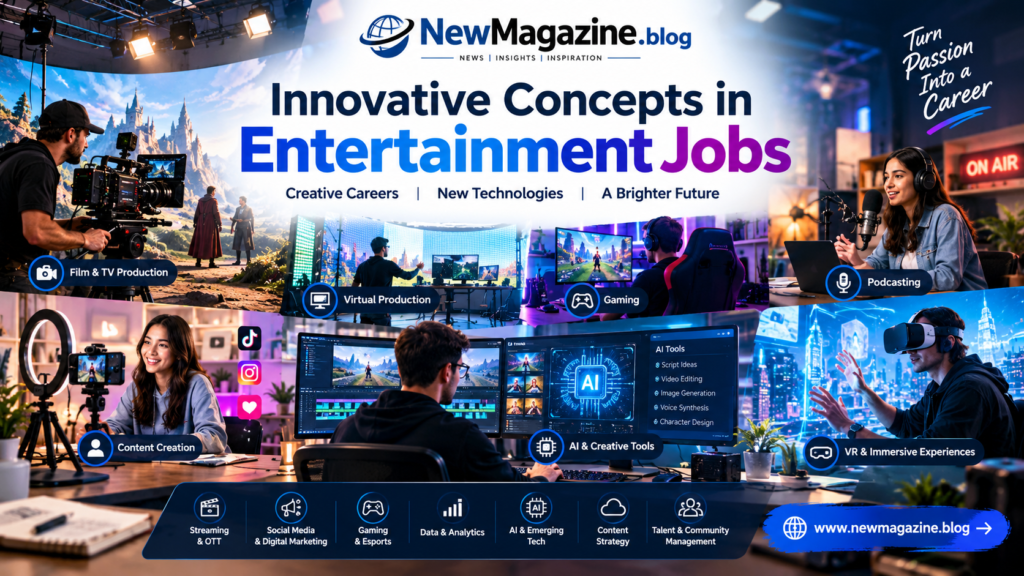

The entertainment industry has never stood still. Movies, television, music, gaming, live events and digital media have always evolved alongside new technology, but the pace of change has accelerated dramatically in recent years. Streaming platforms changed how audiences watch content. Social media transformed how creators build audiences. Gaming became a major entertainment ecosystem rather than simply a form of recreation. Artificial intelligence is now influencing production, marketing, localization and content development, while virtual production and immersive technologies are creating experiences that were difficult to imagine a generation ago.
These changes are also reshaping employment. Someone interested in entertainment no longer has to become an actor, singer, director or television producer to build a career in the industry. There are opportunities in data analytics, virtual production, audience development, creator management, gaming, immersive media, artificial intelligence, digital marketing, intellectual property, community management and many other areas. This guide explores the most important innovative concepts in entertainment jobs, explains why these careers are emerging, identifies the skills employers increasingly value and provides practical advice for people who want to enter this changing industry.
What Are Innovative Concepts in Entertainment Jobs
Innovative concepts in entertainment jobs are new or evolving approaches to careers created by changes in technology, audience behavior, content distribution and entertainment business models. Traditional entertainment roles remain important, but many modern positions combine creative expertise with technology or business skills. A person might work as a virtual production specialist, audience data analyst, creator partnerships manager or AI content workflow specialist without following the conventional Hollywood career path. The important concept is that entertainment employment is becoming more interdisciplinary. Creativity still matters, but it increasingly works alongside analytics, software, digital platforms and audience strategy.
Why Entertainment Jobs Are Changing
Consumers now discover and consume entertainment across many platforms. A single entertainment brand can have a streaming series, social media presence, podcast, video game, merchandise ecosystem and live event strategy. That creates demand for professionals who understand how different parts of the ecosystem work together. A marketing professional who understands TikTok, YouTube analytics and audience segmentation may be as valuable to a modern entertainment company as someone with traditional advertising experience. Technology is another major driver. Tools involving artificial intelligence, real time rendering, virtual reality and automated production are changing workflows throughout the industry.
Emerging Entertainment Careers
The modern entertainment industry includes a much broader collection of careers than the traditional actor director producer model. Emerging roles are often built around technologies and business models that did not exist, or were not commercially important, twenty years ago. Some are entirely new occupations, while others are traditional jobs that now require a significantly different skill set.
AI Entertainment Specialist
Artificial intelligence is becoming part of creative and operational workflows across entertainment. Professionals may use AI tools for research, content development, audience analysis, localization, production planning or workflow automation. An AI entertainment specialist does not necessarily need to be a machine learning engineer. In many organizations, the valuable skill is understanding how AI can be integrated responsibly into an existing creative process. For example, a professional might help a production company identify repetitive tasks that can be automated while ensuring that human creators remain responsible for important creative decisions.
Virtual Production Specialist
Virtual production combines filmmaking with real time computer graphics, LED stages, game engine technology and digital environments. Instead of filming every scene in a physical location, production teams can create digital environments that appear on large LED screens or are generated in real time. This approach can provide filmmakers with more control over lighting, backgrounds and visual effects. Careers in this area can include virtual production supervisors, real time artists, technical directors, LED technicians and environment artists.
Entertainment Data Analyst
Entertainment companies generate enormous amounts of audience data. Streaming services can analyze viewing behavior, while social platforms provide information about engagement, demographics and content performance. Entertainment data analysts turn this information into useful insights. They may evaluate audience behavior, campaign performance, content trends, retention or marketing results. This makes data analytics one of the strongest examples of an Innovative Concepts in Entertainment Jobs entertainment career because it combines quantitative skills with an understanding of audience psychology and content.
Creator Economy Jobs
The creator economy has created an entirely different category of entertainment employment. Individual creators increasingly operate like small media companies. They may produce videos, podcasts, newsletters, livestreams, merchandise and subscription communities. As their businesses grow, they require support from editors, managers, marketers, producers and partnership specialists.
Creator Partnerships Manager
Creator partnerships managers connect creators with brands, platforms and entertainment companies. Their responsibilities can include identifying suitable creators, negotiating partnerships, coordinating campaigns, evaluating performance and maintaining relationships. The role requires a mixture of communication, marketing, negotiation and analytics skills. Understanding a creators audience can be just as important as understanding the creators content.
Social Media Entertainment Strategist
Entertainment companies need professionals who understand how content behaves differently across platforms. A trailer that performs well on YouTube may need a completely different format for TikTok, Instagram or another short form platform. A social media entertainment strategist develops platform specific content strategies rather than simply reposting the same material everywhere. The job combines storytelling, analytics, trend monitoring and digital marketing.
Creator Community Manager
Large creator brands and digital entertainment businesses often have highly active online communities. Community managers help maintain relationships between creators and audiences. They may moderate discussions, organize digital events, develop engagement campaigns and identify recurring audience feedback. This role is increasingly important because community loyalty can become a significant competitive advantage for entertainment brands.
Gaming and Interactive Entertainment Careers
Gaming is one of the clearest examples of how entertainment has expanded beyond conventional media. Modern games can combine storytelling, music, animation, social interaction, competitive events, virtual economies and live service communities. This creates employment opportunities across creative, technical and commercial disciplines.
Game Narrative Designer
Narrative designers create stories, dialogue, characters and interactive storytelling systems for games. Unlike traditional screenwriting, game narrative design often requires understanding player choice. The story may change depending on what the player does. This makes narrative design particularly attractive to writers who enjoy combining storytelling with technology and interactive experiences.
Esports and Live Gaming Producer
Competitive gaming has developed its own entertainment ecosystem involving tournaments, broadcasters, sponsors, teams, commentators and digital audiences. Esports producers coordinate live broadcasts, event schedules, production crews, graphics, commentators and audience experiences. The job combines event management with broadcasting and digital entertainment.
Game Community and Live Operations Specialist
Many modern games are continuously updated rather than released once and abandoned. Developers need professionals who understand player communities, updates, events and engagement. Live operations specialists help plan recurring content, in game events and community activities. They monitor player behavior and feedback to help maintain long term engagement.
Immersive Entertainment Jobs
Immersive entertainment uses technologies such as virtual reality, augmented reality, spatial computing and interactive installations to create experiences that audiences actively participate in. Instead of watching entertainment from a fixed position, visitors may become part of the experience.
Virtual Reality Experience Designer
VR experience designers create environments and interactions for immersive applications. They may work on entertainment attractions, games, cultural experiences, educational projects or location based entertainment. Successful VR design requires more than technical knowledge. Designers must understand movement, spatial storytelling, user comfort and interaction.
Augmented Reality Content Producer
AR content can add digital elements to the physical world through smartphones, wearable devices and other technologies. Entertainment companies can use AR for games, promotional campaigns, live events, fan experiences and interactive storytelling. Professionals working in this field need to understand both creative production and the technical limitations of augmented reality platforms.
Immersive Event Producer
Concerts, exhibitions, museums and theme attractions are increasingly incorporating interactive technologies. Immersive event producers coordinate technology, performers, designers, venue teams and audience experiences. Their work can include projection mapping, interactive installations, spatial audio and digital environments. This career is ideal for people who enjoy combining event management with creative technology.
Artificial Intelligence and the Future of Entertainment Work
AI is one of the most important forces affecting entertainment employment. It can assist with tasks involving research, editing, translation, recommendation systems, audience analysis and content workflows. However, AI does not simply mean that entertainment jobs disappear. In many situations, the technology changes the tasks people perform rather than eliminating the need for human expertise. Creative judgement, storytelling, leadership, cultural understanding and ethical decision making remain difficult to automate completely.
AI Assisted Content Production
Entertainment professionals increasingly use AI assisted tools for brainstorming, transcription, editing support, translation and other workflow tasks. A future oriented entertainment professional should therefore understand how to use AI as a productivity tool without becoming completely dependent on it. The strongest candidates will often be people who can combine AI literacy with deep expertise in another field.
AI Ethics and Entertainment
The entertainment industry faces important questions about intellectual property, consent, likeness, voice replication and the use of creative works in AI systems. This creates potential careers in AI policy, entertainment law, rights management and ethical technology implementation. People who understand both entertainment and emerging technology may become increasingly valuable as companies establish responsible AI policies.
Streaming and Digital Media Careers
Streaming fundamentally changed the relationship between entertainment companies and audiences. Instead of relying exclusively on cinemas, broadcast schedules or physical media, entertainment businesses can distribute content directly through digital platforms. This creates jobs focused on digital distribution, audience retention, content strategy and platform performance.
Streaming Content Strategist
A streaming content strategist evaluates what audiences watch and how content fits within a platforms broader strategy. The job can involve content research, performance analysis, programming decisions and audience segmentation. A successful strategist needs to understand both creative quality and business objectives.
Audience Development Specialist
Producing good entertainment is only part of the challenge. Companies also need to reach the right audience. Audience development specialists use social media, email, search, partnerships, communities and digital advertising to grow awareness and engagement. Their work is particularly valuable for independent creators and smaller entertainment companies competing with much larger brands.
Entertainment Marketing and Technology
Marketing has become increasingly data driven. Entertainment companies can track campaign performance across search, social media, video platforms, email and advertising networks. This creates opportunities for marketers who combine creative communication with analytical skills.
Entertainment SEO Specialist
Search engine optimization is increasingly relevant to entertainment websites, streaming content, artists, podcasts and digital publications. An entertainment SEO specialist can optimize articles, artist pages, videos, event pages and other digital assets so audiences can discover them through search engines. Knowledge of keyword research, technical SEO, content strategy, structured data and analytics can provide a strong career foundation.
Entertainment Performance Marketing Specialist
Paid advertising can be used to promote movies, concerts, streaming programs, games, artists and events. Performance marketers analyze metrics such as clicks, conversions, engagement and acquisition costs to improve campaigns. This role is particularly suitable for people who enjoy both entertainment and digital marketing.
Data and Analytics Careers in Entertainment
Data is increasingly used to understand audience behavior, predict demand and measure content performance. Entertainment companies can use analytics to understand what audiences watch, listen to, purchase or share.
Audience Insights Analyst
Audience insights analysts examine behavioral data to identify patterns in consumer preferences. They may work with survey data, streaming information, social media metrics, ticket sales or other datasets. Strong analytical ability combined with communication skills is essential because the analyst must translate complex information into decisions that creative and business teams can understand.
Entertainment Business Intelligence Specialist
Business intelligence professionals build dashboards, reports and analytical systems that help entertainment organizations make better decisions. They may evaluate revenue, marketing performance, content consumption, customer acquisition or operational efficiency. This career is a strong example of the convergence between technology and entertainment because it applies business analytics to creative industries.
Podcast and Audio Entertainment Careers
Podcasts have expanded the entertainment ecosystem and created opportunities for producers, editors, hosts, researchers, marketers and audience development specialists. Audio entertainment can operate independently or alongside larger media organizations.
Podcast Producer
Podcast producers coordinate the creative and technical elements of a show. Responsibilities may include episode planning, guest coordination, research, recording, editing supervision and distribution. The role is attractive because podcast production can be performed for companies, independent creators, news organizations and entertainment brands.
Audio Content Strategist
An audio content strategist determines what types of programs an audience is likely to engage with and how those programs should be distributed. They may analyze listening behavior, identify topics, develop programming schedules and coordinate promotional strategies. This role combines storytelling with audience analytics.
Entertainment Jobs in Live Events
Live entertainment continues to provide employment despite the growth of digital media. Concerts, festivals, sports entertainment, conventions, theater productions and immersive attractions all require large teams.
Experience Designer
Experience designers focus on the audiences complete journey through an event. They consider everything from arrival and navigation to visual design, interaction, entertainment and departure. The role is increasingly influenced by digital technologies, allowing events to combine physical and virtual experiences.
Event Technology Specialist
Modern events may depend on ticketing systems, digital displays, livestreaming, mobile applications, interactive installations and audience analytics. Event technology specialists make these systems work together. This career is suitable for people interested in technology but who also want to work in creative and entertainment environments.
Skills Needed for Innovative Concepts in Entertainment Jobs
The most valuable skill sets increasingly combine creativity with technology. A person does not necessarily need to master every technology in the industry. Instead, the goal should be to develop a strong primary discipline and then add complementary skills.
Digital and Technical Skills
Useful technical skills can include analytics, video editing, digital advertising, search engine optimization, social media management, AI tools, data visualization, game engines, virtual production technology or content management systems. The specific skills required depend on the career path. Someone pursuing entertainment marketing may benefit more from Google Analytics, paid advertising and SEO than from learning 3D modeling, while a virtual production artist may need entirely different technical capabilities.
Creative and Communication Skills
Technology does not replace communication. Entertainment professionals still need to write clearly, present ideas, collaborate with teams, understand audiences and solve creative problems. Storytelling is particularly valuable because entertainment is ultimately built around human attention and emotion.
Education and Training for Entertainment Careers
There is no single educational route into the modern entertainment industry. Film schools, universities and specialized training programs can be valuable, but practical experience and portfolios can be equally important for many digital roles. A person interested in entertainment technology might study computer science, digital media, marketing, design, film production, game development or communications.
Build a Portfolio Instead of Relying Only on Qualifications
A portfolio provides evidence of what you can actually do. An aspiring entertainment marketer could create a mock promotional campaign. A video editor could produce a short showreel. A game narrative designer could create an interactive story. An aspiring podcast producer could launch a small podcast. These projects demonstrate initiative and practical ability.
Learn Through Real Projects
Real projects expose you to deadlines, feedback and technical problems that classroom exercises may not fully replicate. Volunteer for events, collaborate with independent creators, work on student productions or build your own digital entertainment project. Experience becomes particularly valuable when it can be documented with measurable results.
How to Start a Career in Entertainment
Breaking into entertainment can be competitive, but the industry expansion creates more entry points than the traditional studio system offered. Instead of focusing only on famous companies, consider independent production companies, streaming businesses, agencies, creator businesses, gaming companies, event organizations and digital media startups.
Find a Specific Career Direction
Entertainment is too broad to function as a career plan. Choose an area such as entertainment marketing, production, gaming, podcasting, audience analytics, virtual production or creator management. Once you have a direction, identify the three to five skills most frequently required for that role and build them systematically.
Network With Entertainment Professionals
Relationships are extremely important in entertainment. Attend industry events, join professional communities, participate in online discussions and connect with people whose work interests you. Networking should not mean immediately asking strangers for jobs. A better strategy is to learn from professionals, contribute useful ideas and gradually develop genuine professional relationships.
Remote and Freelance Entertainment Jobs
Digital entertainment has created more opportunities for remote and freelance workers. Video editors, graphic designers, social media managers, writers, SEO specialists, podcast editors, researchers and digital marketers can often work with entertainment clients without living in major media centers. This has lowered some geographic barriers to entry.
Freelancing as an Entry Point
Freelancing allows beginners to build a portfolio while earning experience. A new entertainment professional might start by editing short form videos, managing social media accounts, creating promotional graphics or researching content ideas. The objective should not simply be to complete random freelance tasks. Try to specialize in entertainment related clients so that your portfolio develops a clear professional identity.
Reviews and Outlook for Emerging Entertainment Careers
The outlook for innovative entertainment careers is strongest where creative skills intersect with growing technology and audience demand. Roles involving digital content, gaming, AI, analytics, social media, streaming and immersive experiences have particularly strong potential because these areas continue to evolve. However, emerging careers can also be less predictable than traditional occupations. Technologies change quickly, platforms can lose popularity and job titles can evolve.
Which Skills Have the Longest Term Value
Transferable skills are usually safer than platform specific knowledge. Storytelling, communication, analytical thinking, project management, creativity, collaboration and audience understanding can remain useful even when particular technologies change. Technology specific skills are still valuable, but they should be treated as tools that complement deeper professional capabilities.
Why Are Innovative Concepts in Entertainment Jobs Trending
Innovative Concepts in Entertainment Jobs are trending because audiences are consuming content differently and entertainment companies are experimenting with new technologies and business models. Streaming, social media, gaming, creator platforms, virtual production and immersive experiences have expanded the number of ways entertainment can be created and distributed. At the same time, companies want employees who can work across disciplines.
The Creator Economy Is Expanding Career Options
Creators can now build businesses without traditional media gatekeepers. A successful creator may require a team covering production, editing, marketing, partnerships, community management and business operations. That means one creator can indirectly support several different entertainment careers.
Technology Is Creating New Production Models
Real time graphics, AI assisted workflows and immersive technology allow smaller teams to produce experiences that once required significantly larger resources. This does not eliminate traditional entertainment jobs. Instead, it changes the production process and creates demand for people who understand the new tools.
Latest Update on Entertainment Careers
The entertainment employment landscape in 2026 is increasingly shaped by the convergence of AI, streaming, gaming, social platforms, data and immersive technology. AI related changes deserve particular attention because organizations are experimenting with new ways to incorporate automation and generative tools into creative and business workflows. At the same time, legal, ethical and labor considerations mean that human oversight remains essential. For job seekers, the practical lesson is not simply to learn AI. It is to understand how AI can improve a specific entertainment function while developing strong human skills that technology cannot easily replace.
What Employers Are Looking For
Employers increasingly value candidates who can demonstrate practical results. Instead of simply listing social media or video editing on a resume, candidates can demonstrate what they created, which audience they reached and what measurable outcome they achieved. A portfolio containing real examples can therefore make an applicant more competitive than a long list of generic skills.
Explore more Entertainment Careers insights on NewMagazine.blog.
Conclusion
The future of entertainment employment is broader than the traditional careers most people associate with movies, television and music. Innovative concepts in entertainment jobs are emerging from the intersection of creativity, technology, data and changing audience behavior. AI assisted production, virtual production, gaming, creator management, immersive experiences, streaming analytics, entertainment marketing and digital communities are opening new pathways for professionals with different backgrounds. The most successful candidates are unlikely to be those who simply chase every new technology. Instead, they will develop a strong core skill and learn how emerging tools can make that skill more valuable.
For someone starting today, the opportunity is significant. You can build experience through independent projects, freelance work, digital platforms and collaboration without necessarily waiting for a traditional entertainment company to offer you an entry level position.
Frequently Asked Questions About Innovative Entertainment Jobs
What are innovative concepts in entertainment jobs?
Innovative concepts in entertainment jobs are emerging career opportunities created by technology, changing audience behavior and new entertainment business models. Examples include virtual production, AI assisted entertainment, creator management, entertainment analytics, immersive experiences and gaming careers.
What are the most promising new entertainment careers?
Promising areas include entertainment data analytics, AI assisted production, virtual production, gaming, creator partnerships, immersive experience design, digital audience development and entertainment technology. The strongest career choice depends on your existing skills and interests rather than simply following a trend.
Do I need a degree to work in entertainment?
Not always. Some roles benefit from formal education, particularly specialized technical, production or business positions, but many digital entertainment careers place significant value on portfolios and practical experience. Building projects, gaining freelance experience and developing industry connections can complement or sometimes substitute for traditional credentials depending on the position.
Can I work in entertainment remotely?
Yes. Many digital entertainment roles can be performed remotely, including video editing, social media management, SEO, digital marketing, writing, podcast editing, graphic design and some analytics positions. Jobs involving physical production, live events and studio operations generally require more on site work.
How is AI changing entertainment jobs?
AI can assist with research, editing, translation, content workflows, audience analysis and other repetitive tasks. It can also create demand for professionals who understand how to integrate AI into creative processes responsibly. Human creativity, judgment, rights management, cultural understanding and ethical decision making remain important.
What skills should I learn for a future entertainment career?
Start with skills that match your chosen specialization. Digital marketing, video production, analytics, storytelling, communication, project management, AI literacy and social media strategy are broadly useful. Avoid trying to learn everything at once. Develop one strong professional skill and add complementary technologies around it.
Is gaming considered an entertainment career field?
Absolutely. Gaming includes game development, narrative design, animation, esports, broadcasting, community management, production, marketing and live operations. The industry also increasingly overlaps with music, film, social media and live entertainment.
How can beginners get experience in entertainment?
Create your own projects, freelance for small clients, volunteer at events, collaborate with independent creators and build a portfolio. The most useful early experience is work that demonstrates a specific skill and produces something you can show future employers or clients.