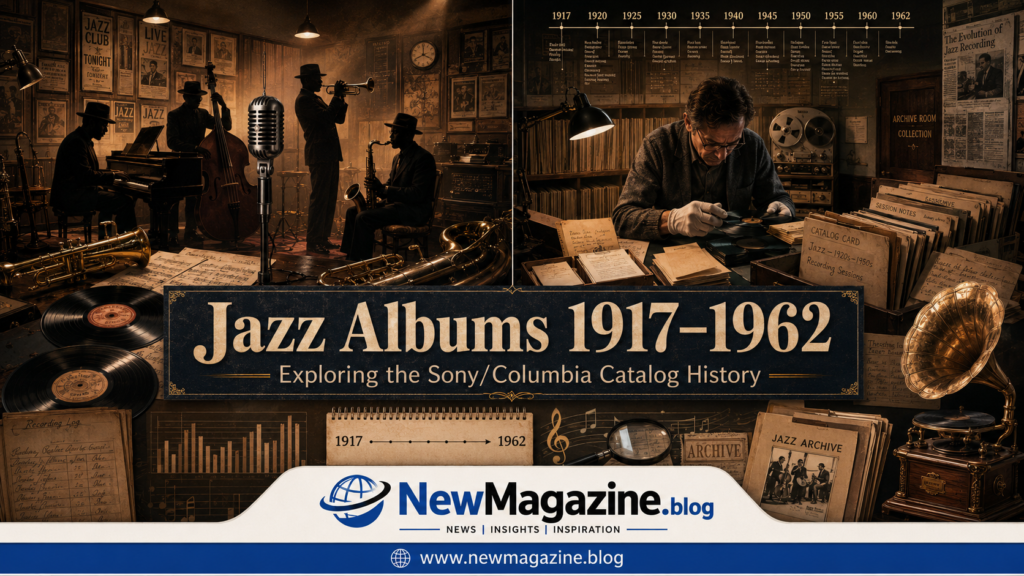

How Many Jazz Albums Did Sony/Columbia Release Between 1917 1962? Anyone researching Columbia Records early jazz output eventually runs into the same wall there is no single, official, publicly confirmed number for exactly how many jazz albums the label released between 1917 and 1962.
That is not for lack of interest Columbias jazz catalog from this period includes some of the most historically significant recordings ever made but the way the label operated, and the way album it self changed as a format during these 45 years, makes a single precise count something that does not currently exist in any published source.
This article lays out exactly what is documented about Columbias jazz output during this period, why an exact total has never been publicly compiled, and where the real research trail actually leads if you want to dig deeper.
There is no publicly confirmed, official total for how many jazz albums Columbia Records released between 1917 and 1962. No comprehensive, itemized count from this specific 45 year span has been published by Sony Music, Columbias historical archives, or any major discography project that this article could verify.
Part of the reason is structural the word album did not mean what it means today for most of this period the long playing LP record was not introduced until 1948, meaning the first three decades of this range consist of individual 78 rpm singles and multi disc album sets rather than the single LP format most people picture when they hear jazz album. Additionally, Sony/Columbia as a combined entity did not exist during this period at all Sony did not acquire Columbias parent company, CBS Records, until 1988, decades after 1962.
Key Facts Table
| Category | Detail |
|---|---|
| Columbia Records founded | 1888 (as a phonograph company; became a major recording label in the following decades) |
| Start of the “jazz era” (as commonly dated) | 1917, tied to the first commercially released jazz recordings |
| Columbia’s early ODJB session | Recorded January 1917, but shelved by Columbia executives at the time |
| First jazz record commercially released | February 1917, recorded by the Original Dixieland Jass Band — for Victor, not Columbia |
| Columbia’s acquisition of OKeh Records | 1926, adding a major jazz and blues catalog including Louis Armstrong |
| CBS acquisition of Columbia | 1938 (via its purchase of the American Record Corporation) |
| Introduction of the LP record | 1948, fundamentally changing what an “album” meant going forward |
| Sony’s acquisition of CBS Records | 1988, creating what’s now referred to as “Sony/Columbia” |
| Confirmed total jazz album count, 1917–1962 | Not publicly documented in any verifiable source |
Why This Number Does not Publicly Exist
Before getting into what is documented, it is worth explaining clearly why a precise total for this specific question has not been published anywhere verifiable. A few structural realities make it a genuinely difficult figure to produce
Album meant something different for most of this period. For the first 31 years of this 45 year span, Columbia released music almost entirely as individual 78 rpm singles, occasionally bundled into multi disc album sets physical folders containing several 78s. The long playing record the format most people associate with the word album today was not introduced by Columbia until 1948. Any attempt to count jazz albums across the full 1917 1962 range has to first decide how to treat nearly three decades of singles based releases, and that decision alone can dramatically change the resulting total.
Columbias catalog was not organized by genre for most of its history. Jazz, blues, pop, classical, and other genres were often mixed within the same catalog numbering sequences, particularly in the labels early decades, making it difficult to cleanly separate jazz releases from everything else without a dedicated, artist by artist research effort.
Columbia absorbed other labels catalogs. The 1926 acquisition of OKeh Records brought an entirely separate jazz and blues catalog under the Columbia corporate umbrella, raising the question of whether OKeh era jazz releases should count toward a Columbia total at all, or should be tracked separately.
Sony/Columbia is an anachronistic label for this era. Sony did not exist as Columbias corporate parent until its 1988 acquisition of CBS Records more than 25 years after the end date in this question. During the actual 191 1962 period, the label operated first independently, then as part of the American Record Corporation, and then as a division of CBS starting in 1938. Framing the question as Sony/Columbia reflects the labels modern branding rather than its historical corporate structure during the years in question.
No dedicated, published discography covers exactly this range. Serious discographers have documented specific slices of Columbias jazz output individual artists, specific catalog number ranges, or particular sub periods but this article could not identify a single published source that totals jazz albums specifically across the full 1917 1962 span as one number.
What Actually Is Documented Columbias Jazz History, Era by Era
While an exact count does not exist, Columbias jazz history during this period is extremely well documented in terms of artists, key releases, and turning points. Piecing that history together gives a much clearer, if less numerically precise, picture of the labels actual jazz footprint.
1917 1925 The Earliest Jazz Years
The year 1917 is commonly cited as the starting point for recorded jazz, and Columbia has an interesting, often overlooked role in that story. The Original Dixieland Jass Band recorded a session for Columbia in January 1917, but label executives at the time reportedly considered the material too unconventional and shelved it. The band then recorded for Victor the following month, and that Victor session not Columbias produced Livery Stable Blues, widely credited as the first jazz record ever commercially released. Columbia eventually released its own earlier ODJB recording later on, but Victor had already claimed the historical first.
Beyond that early misstep, Columbias catalog through the early 1920s included blues and jazz adjacent artists within its broader Race record series numbered 14000 D, most notably Bessie Smith, whose recordings for Columbia beginning in 1923 became some of the most commercially and artistically significant blues recordings of the decade.
1926 1934 The OKeh Acquisition and Expanding Catalog
Columbias 1926 acquisition of OKeh Records substantially deepened its jazz and blues holdings, bringing artists including Louis Armstrong and Clarence Williams into the broader Columbia corporate family, even as OKeh often continued operating with its own separate catalog identity. Around the same period, bandleader Paul Whitemans symphonic jazz recordings, including sessions featuring cornetist Bix Beiderbecke in 1928, became some of Columbias most commercially significant jazz adjacent releases of the era.
This period was also financially turbulent for the label. Columbia struggled through the Great Depression and was sold to the American Record Corporation in 1934, a corporate transition that adds yet another layer of complexity to any attempt to cleanly track Columbia releases as a single continuous catalog through these years.
1935 1947 The CBS Era Begins
In 1938, CBS acquired the American Record Corporation, bringing Columbia Records under CBS ownership for the first time the corporate structure that would define the label for the following five decades. This period included some of the most significant swing and early bebop adjacent jazz in Columbias catalog Count Basies Kansas City swing recordings from 1942 to 1946, Charlie Christians genre shifting guitar work with the Benny Goodman Sextet from 1939 to 1941, and Woody Hermans influential First Herd recordings from 1945 to 1946.
1948 1953 The LP Revolution
Columbias introduction of the 33⅓ rpm long playing record in 1948 fundamentally reshaped what an album meant going forward. Prior to this point, a jazz album typically referred to a bound folder containing several individual 78 rpm discs. After 1948, a single LP could hold what previously required an entire multi disc set, and Columbia spent the following years transitioning its catalog, gradually reissuing older material on the new format alongside newly recorded LP releases.
1953 1962 Columbia Becomes a Major Jazz Label
According to retrospective academic coverage of this period, including analysis presented through Webster University jazz programming, Columbia specifically earned its reputation as a jazz record label of consequence starting around 1953, a shift that accelerated through the rest of the decade and into the early 1960s. This era included some of the most significant jazz recordings in American history released on the label
Dave Brubeck, whose Columbia recordings made him one of the labels most commercially successful jazz artists of the era, with his 1959 album Time Out released just after this articles 1962 cutoff window began wrapping up its most active phase building on years of Columbia releases throughout the 1950s.
Miles Davis, signed to Columbia in 1956, whose sextet released the modal jazz landmark Milestones in 1958 and the genre defining Kind of Blue in 1959 an album frequently ranked among the greatest of all time.
Duke Ellington, who recorded for Columbia sporadically going back to the pre LP era, became a regular Columbia artist starting in 1955 and continued recording for the label consistently through 1962, including a notable stretch of sessions during May and June of 1960 that produced three separate albums.
Thelonious Monk, who joined Columbias roster during this period, part of a broader pattern of Columbia signing some of the most influential names in jazz throughout the decade.
Coverage of Columbias business during this era also notes that the label was one of the big five American record labels of the 1950s, alongside Capitol, Decca, Mercury, and RCA, releasing well over a hundred records annually across all genres combined with jazz representing a meaningful, but not dominant, share of that broader output, since the label’s largest commercial focus remained pop, classical, and mainstream vocal recordings.
Why Miles Davis Catalog Offers a Useful But Limited Data Point
One of the more concrete data points available for understanding Columbias jazz output during part of this period comes from Miles Davis own catalog specifically. The 2009 box set Miles Davis The Complete Columbia Album Collection, released by Sony Legacy reissue division, compiles 52 albums across 70 CDs spanning Davis full career on the label from 1949 to 1989. Within that collection, a meaningful number of albums fall specifically within the 1949 1962 window relevant to this article, including Miles Ahead, Porgy and Bess, Kind of Blue, Sketches of Spain, Someday My Prince Will Come, and two separate live recordings from the Blackhawk club in 1961.
While this gives a precise, artist specific count for one of Columbias most significant jazz signings, it is important to understand its limits it only covers Miles Davis, one artist among dozens who recorded jazz for Columbia during this period. Extrapolating a label wide total from a single artists catalog would be a significant overreach, but it does illustrate just how active the labels jazz output could be with even one signed artist during these years.
Where the Real Research Trail Leads
For anyone seriously trying to answer this question with original research rather than an estimate, a few types of resources come closest to making that kind of count possible, even though none currently publish the specific 1917 1962 jazz only total as a single finished figure
Catalog number discography projects. Dedicated discography researchers have published detailed, numbered breakdowns of Columbias album releases by catalog number range and release year the kind of resource that could theoretically be used to manually identify and count jazz specific releases within a defined period, though this requires significant manual cross referencing rather than pulling from a single existing total.
Specialized jazz discographies. Published jazz discography projects that focus specifically on artist sessions and label output during the 78 rpm and early LP eras are the most likely source of a rigorously researched count, though this article did not identify one that has published a single finished total specifically bounded to Columbias output between exactly 1917 and 1962.
Sony Legacys own archival releases. Sony Legacy reissue division has periodically compiled retrospective jazz collections drawing from Columbias historical catalog, including the This Is Jazz compilation series released between 1996 and 1998, though these are curated retrospective samplers rather than exhaustive historical counts.
Timeline Columbia Records and Jazz, 1917 1962
January 1917 The Original Dixieland Jass Band records for Columbia, but the label shelves the material.
February 1917 The same band records for Victor instead, producing what was widely regarded as the first commercially released jazz record.
1923 1929 Bessie Smith records a series of blues recordings for Columbia that become touchstone releases of the era.
1926 Columbia acquires OKeh Records, gaining a substantial jazz and blues catalog, including Louis Armstrong.
1928 Paul Whitemans symphonic jazz recordings, including sessions with Bix Beiderbecke, are released on Columbia.
1934 Columbia is sold to the American Record Corporation amid Depression era financial difficulty.
1938 CBS acquires the American Record Corporation, bringing Columbia Records under CBS ownership.
1939 1941 Charlie Christian records with the Benny Goodman Sextet for Columbia, helping shape the sound of early bebop guitar.
1942 1946 Count Basie records Kansas City swing recordings for the label.
1945 1946 Woody Hermans First Herd records for Columbia.
1948 Columbia introduces the 33⅓ rpm long playing record, transforming what album means for all future releases.
1953 Columbia begins building its reputation as a jazz label of consequence, according to retrospective academic coverage.
1955 Duke Ellington becomes a regular, consistently recording Columbia artist.
1956 Miles Davis signs to Columbia.
1958 Miles Davis sextet releases Milestones.
1959 Miles Davis sextet releases Kind of Blue.
1962 Duke Ellingtons consistent annual Columbia recording streak, which began in 1955, comes to an end, closely aligning with this articles end date.
Expert Analysis Why Precise Historical Discographies Are So Hard to Compile
Music historians and archivists who specialize in early 20th century record label research point to a few recurring challenges that explain why questions like this one rarely have a single, clean published answer
Record labels historically did not keep genre specific release logs. Companies like Columbia tracked releases by catalog number and release date for business purposes, not by genre classification meant to support future historical research, meaning any genre specific count has to be reconstructed after the fact.
Corporate acquisitions fragment historical catalogs. Columbias absorption of OKeh Records, its own 1934 sale, and its later 1938 acquisition by CBS all mean that Columbias catalog is not a single continuous, cleanly bounded dataset even from a purely corporate history standpoint.
Formats changed mid period in ways that complicate any single count. A count that includes only LP era jazz albums would exclude nearly three decades of pre 1948 output, while a count that includes 78 rpm album sets alongside true LPs risks conflating two genuinely different product formats under the same label.
Original research requires access to physical archives. A truly comprehensive count would likely require direct access to Columbias historical business records, session logs, and release schedules materials that, even where they still exist, are not fully digitized or publicly searchable in a way that would let a researcher generate this kind of total from publicly available sources alone.
Public & Social Media Reaction
Interest in questions like this one tends to come from a specific, dedicated audience rather than casual listeners, and that is reflected in how the topic circulates online
Vinyl collectors and jazz discography enthusiasts frequently raise similar questions in dedicated forums and collector communities, generally arriving at the same conclusion that no single, authoritative total has been published, and that serious researchers rely on catalog number cross referencing rather than a single existing source.
Music historians occasionally note the broader irony that a label as commercially significant as Columbia has had its historical jazz catalog documented in fragments artist by artist, era by era rather than compiled into one comprehensive historical record, despite the catalogs enormous cultural significance.
Some online discussion around Sony Legacy periodic archival box sets, like the Miles Davis collection, reflects appreciation for the depth of artist specific documentation Sony has made available, even as broader label wide historical totals remain uncompiled.
Comparisons What Can and Can not Be Counted
| Data Point | Is a Precise, Documented Number Available? |
|---|---|
| Total jazz albums, Columbia, 1917–1962 | No — not publicly documented in any verifiable source |
| Miles Davis’s Columbia albums, 1949–1989 | Yes — 52 albums, per Sony Legacy’s 2009 box set |
| Year Columbia introduced the LP | Yes — 1948 |
| Year CBS acquired Columbia’s parent company | Yes — 1938 |
| Year Sony acquired CBS Records (“Sony/Columbia”) | Yes — 1988 |
| Number of albums in Sony Legacy’s “This Is Jazz” series | Yes — at least 27 entries released between 1996 and 1998 |
Myths vs Facts
Myth There is a well known, widely cited number for How Many Jazz Albums Did Sony/Columbia Release Between 1917 1962
Fact No such number has been identified in any verifiable, published source. Specific artist catalogs and eras are well documented a single combined total for this exact range is not.
Myth Sony/Columbia accurately describes the labels ownership during this period.
Fact Sony did not acquire CBS Records, Columbias parent company, until 1988 more than 25 years after 1962. During the 1917 1962 period, the label was independent, then part of the American Record Corporation, then part of CBS starting in 1938.
Myth Jazz albums existed as a consistent format throughout this entire period.
Fact The long playing record was not introduced until 1948. For the first 31 years of this range, jazz releases came almost entirely as individual 78 rpm singles or multi disc 78 rpm album sets, not the single LP format most people associate with the word today.
Myth Columbia was primarily a jazz label during this era.
Fact Columbia was one of the big five major labels of the 1950s, but jazz represented a meaningful, not dominant, share of its overall catalog, with pop, classical, and mainstream vocal music generally driving the bulk of its commercial output.
Myth The Original Dixieland Jass Bands first jazz record was released by Columbia.
Fact While the band recorded for Columbia first, in January 1917, that session was shelved. Their subsequent February 1917 session for Victor produced the actual first commercially released jazz record.
Stay Connect With Us:
Conclusion
The honest answer to how many jazz albums Columbia Records released between 1917 and 1962 is that nobody has published a verified, comprehensive count and understanding why turns out to be almost as interesting as the number itself would have been. Between a 31 year stretch before the LP even existed, a major corporate acquisition that folded in an entirely separate jazz catalog, and a change of ownership structure that makes Sony/Columbia a genuinely anachronistic label for this era, the question sits at the intersection of format history, corporate history, and incomplete public archives.
What is clear, and well documented, is that Columbias jazz output during these decades from Bessie Smith through Miles Davis and Duke Ellington helped shape the sound of American jazz as much as any labels catalog from the era, even without a single number attached to summarize it.
Frequently Asked Questions
How many jazz albums did Columbia Records release between 1917 and 1962?
There is no publicly confirmed, documented total for this specific figure. Columbias jazz catalog during this era is well documented by artist and era, but not compiled into one comprehensive count.
Why does not this number exist publicly?
Because record formats changed dramatically during this period 78 rpm singles through 1948, LPs afterward, the labels catalog was not organized by genre, and no published discography project has compiled a jazz specific total across this exact 45 year span.
Is Sony Columbia the correct name for the label during this period?
No. Sony did not acquire Columbias parent company, CBS Records, until 1988, decades after 1962. During 1917 1962, the label operated independently, then under the American Record Corporation, then under CBS starting in 1938.
When did Columbia release its first jazz related recordings?
Columbia recorded the Original Dixieland Jass Band in January 1917, though that session was shelved the bands subsequent Victor session the following month produced the first commercially released jazz record instead.
When did Columbia introduce the LP record?
In 1948, fundamentally changing what an album meant for jazz and every other genre going forward.
Did Columbia own any other jazz focused labels during this period?
Yes, it acquired OKeh Records in 1926, gaining a substantial jazz and blues catalog including Louis Armstrong.
Who were some of Columbias most significant jazz artists during this period?
Duke Ellington, Miles Davis, Dave Brubeck, Thelonious Monk, Count Basie, Charlie Christian, and Woody Herman all recorded significant jazz music for Columbia during parts of this era.
Is there a documented count for any individual Columbia jazz artists catalog?
Yes, Sony Legacys 2009 box set documents 52 total Miles Davis albums released on Columbia from 1949 to 1989, offering a precise, artist specific figure, though it extends beyond this articles 1962 cutoff.
What was Columbias position among other record labels in the 1950s?
It was considered one of the big five major American labels, alongside Capitol, Decca, Mercury, and RCA.
Did Columbia release more jazz or more non jazz music during this era?
Non jazz genres, including pop, classical, and mainstream vocal music, generally made up the larger share of Columbias overall commercial output, even as its jazz catalog became historically significant.