
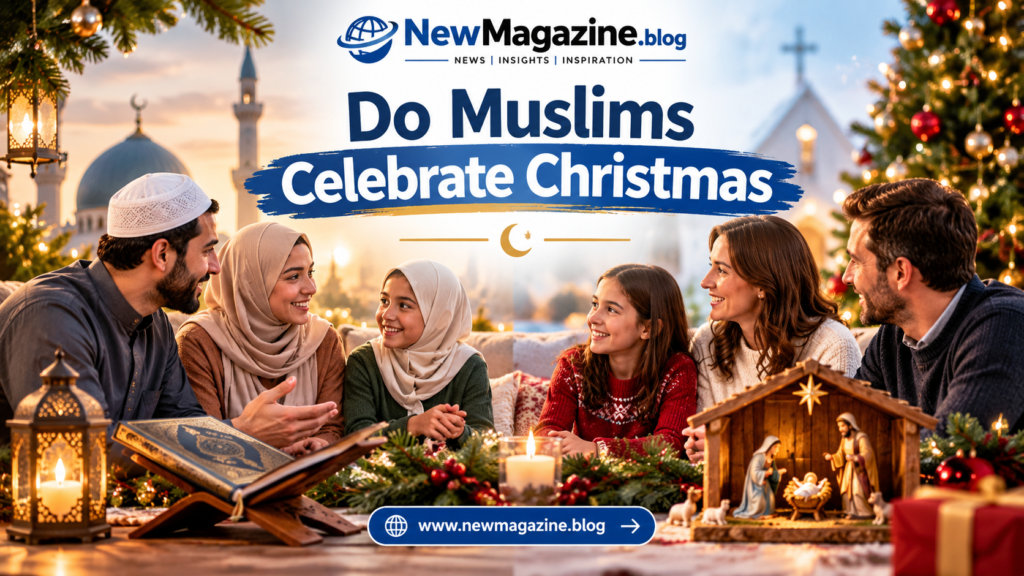

Do Muslims celebrate Christmas Generally, Muslims do not observe Christmas as an Islamic religious holiday. Christmas is a Christian festival associated with the birth of Jesus Christ, while Muslims regard Jesus, known in Arabic as Isa, as an important prophet and messenger of God rather than the divine Son of God. However, the answer becomes more nuanced when the question involves family gatherings, Christmas dinners, gifts, greetings, workplace celebrations, or living in a predominantly Christian country.
Muslim communities and Islamic scholars do not all approach every social situation in exactly the same way. Some scholars advise Muslims not to participate in Christmas celebrations, while others distinguish between taking part in religious rituals and maintaining family or social relationships without participating in religious practices. Understanding the difference between respecting Christmas, participating socially, and observing Christmas as a religious holiday is therefore important.
What Is Christmas
Christmas is a Christian celebration associated with the birth of Jesus Christ. It is traditionally observed on December 25 in many Christian communities, although different Christian traditions may use different calendars or observances. In modern societies, Christmas can also have cultural, commercial, family, and secular elements alongside its religious meaning. For Christians, the religious significance of Christmas is connected to beliefs about Jesus birth and identity. For Muslims, Jesus is also a deeply respected figure, but Islamic theology understands his identity differently. This difference is central to understanding why Christmas is generally not considered a Muslim religious festival.
The date December 25 is part of the Gregorian calendar, whereas Islamic religious dates follow the Islamic lunar calendar. Islamic holidays therefore move through the Gregorian calendar from year to year rather than remaining fixed on a particular Gregorian date.
Do Muslims Celebrate Christmas
For most Muslims, Christmas is not an Islamic holiday and is not observed as one of the religious celebrations of Islam. Muslims have their own major religious festivals, most notably Eid al Fitr and Eid al Adha. This does not mean Muslims necessarily have hostility toward Christmas or toward Christians. A Muslim can respect Christian neighbors, relatives, coworkers, and friends while maintaining a different religious identity. In fact, contemporary Islamic discussions about Christmas frequently distinguish between respecting other peoples celebrations and personally observing a religious festival.
Some Islamic scholars take a strict position that Muslims should not celebrate Christmas or participate in its religious customs. Other scholars make distinctions between religious participation and social interaction, particularly when Muslims have Christian relatives or live in predominantly Christian societies.
Who Is Jesus in Islam
Jesus occupies a highly respected position in Islam. Muslims believe that Jesus, or Isa ibn Maryam, was a prophet and messenger of God and that he was born miraculously to Mary, known as Maryam in Arabic. The Quran gives considerable attention to Jesus and Mary. Islamic teaching recognizes Jesus as the Messiah and describes his miraculous birth and miracles. Muslims therefore do not reject Jesus rather, they have a specific theological understanding of who he was and what his mission meant.
Islamic sources describe Jesus as one of the great messengers of God. Yaqeen Institute notes that Jesus is mentioned by name repeatedly in the Quran and is regarded as one of the major prophets in Islam. The central difference is that Islam does not teach that Jesus is God or the literal Son of God.
What Do Muslims Believe About the Birth of Jesus
Muslims believe in the miraculous birth of Jesus. The Quranic account describes Mary as receiving the announcement of a child and giving birth to Jesus without a human father. This belief is important because it shows that the disagreement between Islam and Christianity is not about whether Jesus existed or whether his birth was extraordinary. Both traditions attach profound significance to Jesus and Mary, although they interpret his identity and mission differently. For Muslims, the miraculous birth does not make Jesus divine. Instead, it is understood as a sign of Gods power. Islamic teaching also compares the creation of Jesus with Adam in the Quran, emphasizing Gods ability to create in extraordinary ways.
Why Do Most Muslims Not Celebrate Christmas
The main reason is theological rather than personal dislike of Christmas. Muslims generally understand religious festivals as part of their own religious practice, and Christmas is associated with Christian beliefs about Jesus that differ from Islamic beliefs. Islam teaches strict monotheism, known as tawhid. Muslims worship one God and do not regard Jesus as divine. Jesus is honored as a prophet and Messiah, but Islamic theology rejects the belief that he is God or the literal Son of God. Because Christmas is fundamentally associated with Christian religious beliefs, many Muslim scholars conclude that Muslims should not adopt Christmas as their own religious celebration. Some scholars also argue that maintaining distinct religious practices is important for preserving Muslim identity.
Why Is Jesus Important to Muslims If They Do Not Celebrate Christmas
The absence of Christmas from the Islamic religious calendar should not be confused with a lack of respect for Jesus. Muslims are required to believe in Gods prophets, and Jesus is among the prophets recognized in Islam. Muslims also deeply respect Mary. The Quran contains a chapter named after Mary, and her story is central to the Islamic account of Jesus birth. This makes Jesus and Mary important figures in Islamic belief even though Muslims do not celebrate Christmas. The distinction is therefore between believing in Jesus and celebrating Christmas. A Muslim can believe that Jesus was born miraculously, was the Messiah, performed miracles by Gods permission, and was a messenger of God without observing Christmas as a religious holiday.
Do Muslims Believe Jesus Is the Son of God
No. Mainstream Islamic theology does not teach that Jesus is the Son of God in the Christian theological sense. Muslims believe that God is one and does not have a divine child. This is one of the most important theological differences between Islam and Christianity. Muslims honor Jesus while rejecting his divinity. Islamic sources describe Jesus as the son of Mary, a servant and messenger of God, and the Messiah. Yaqeen Institutes overview of Islamic belief explains that Muslims regard Jesus as a prophet and messenger and reject the idea that he is God or the divine Son of God. This distinction helps explain the different religious significance that Christmas has for Christians and Muslims.
Do Muslims Believe Jesus Was Crucified
Islamic belief about the crucifixion differs from mainstream Christian belief. The Quran states that Jesus was not killed or crucified in the way his opponents claimed, and classical Islamic interpretation has generally understood the passage as denying that Jesus was successfully crucified. There are interpretive discussions among Muslim scholars about the precise meaning and details of Quran 4 157. The basic Islamic doctrine, however, is that Jesus was not killed through the crucifixion in the manner traditionally taught by Christianity. This theological difference is another reason Christmas and Christian Easter have different meanings within Islam. Muslims believe in Jesus, but they do not accept the Christian theological framework concerning his divinity, crucifixion, and resurrection.
Can Muslims Attend a Christmas Dinner
This is one of the more complicated questions because attending a family meal is not necessarily identical to observing a religious ceremony. Muslim scholars have expressed different views about how Muslims should handle Christmas gatherings. Some scholars advise Muslims not to participate in Christmas celebrations because they regard the occasion as a religious festival belonging to Christianity. Other scholars distinguish between participating in religious rituals and maintaining family relationships. For example, some contemporary Islamic legal opinions permit social interaction with Christian family members provided the Muslim does not participate in religious rituals. Therefore, a Muslim facing a particular family situation may want to consult a trusted qualified scholar who understands the person’s circumstances and the relevant school of Islamic jurisprudence.
Can Muslims Spend Time With Christian Family at Christmas
Muslims who have Christian relatives may face practical questions that do not arise for someone living in a completely Muslim household. A person may be invited to a family dinner, asked to visit relatives, or expected to participate in a workplace gathering. Some scholars emphasize maintaining family ties and good conduct while avoiding religious participation. Other scholars take a stricter position and advise avoiding Christmas gatherings altogether. The important point is that Muslims do not all have identical family circumstances. A Muslim convert with Christian parents, a Muslim living in a Western country, and a Muslim living in a predominantly Muslim community may face very different situations.
Can Muslims Say Merry Christmas
There is a difference of scholarly opinion concerning Christmas greetings. Some Muslim scholars do not permit Muslims to offer specifically religious Christmas greetings because they believe doing so amounts to approving a religious belief that conflicts with Islamic theology. Other scholars distinguish between a greeting intended as social courtesy and an expression of theological agreement. They may permit certain forms of respectful communication depending on context. This means that a person asking whether Muslims can say Merry Christmas should not assume that every Islamic scholar gives the same answer.
The question belongs to a broader discussion about religious greetings, intention, social relationships, and participation in another religions festival. A Muslim who wants to avoid religious ambiguity may choose a neutral expression such as Happy holidays or simply wish the person well, while another Muslim may follow a different scholarly opinion.
Can Muslims Give Christmas Gifts
Gift,giving is another area where opinions can differ depending on the purpose and context of the gift. A gift given specifically as part of celebrating Christmas can be treated differently by scholars from an ordinary gift exchanged between family members or coworkers during the holiday season. Some scholars discourage or prohibit Muslims from giving Christmas gifts because they consider the practice participation in a non Muslim religious celebration. Other scholars have permitted certain social interactions and gifts where there is no participation in religious rituals. For Muslims dealing with workplace or family situations, the exact circumstances matter. A gift to a Christian neighbor as an act of kindness is not automatically identical to adopting Christmas as ones own religious celebration.
Can Muslims Receive Christmas Gifts
Scholars also differ on receiving gifts from Christian friends, neighbors, relatives, or coworkers. Some Islamic authorities allow Muslims to accept gifts as an act of social courtesy, particularly when refusing the gift would unnecessarily damage a relationship. Other scholars apply stricter rules depending on the nature and purpose of the gift. A practical distinction can therefore be useful accepting a gift politely does not necessarily mean accepting the religious beliefs associated with Christmas. However, individual Muslims may follow different scholarly guidance on whether they should accept Christmas specific gifts or participate in gift exchanges. When in doubt about a specific situation, especially where religious rituals are involved, seeking advice from a qualified local scholar can provide a more precise answer.
Can Muslim Children Celebrate Christmas
Muslim parents may face this question particularly often in countries such as the United States, United Kingdom, Canada, Australia, and other countries where Christmas is highly visible in schools, stores, workplaces, and public spaces. Some Muslim scholars advise Muslim parents not to have their children celebrate Christmas because they regard it as a Christian religious festival. They may instead encourage families to make Eid celebrations especially meaningful for children.
Other scholars make distinctions between attending a school event, participating in a nonreligious activity, and taking part in explicitly Christian worship or religious rituals. Parents should therefore distinguish between a school activity that happens during the Christmas season and an activity that is explicitly religious. The answer can depend on the nature of the event, the familys beliefs, and the interpretation followed by the parents.
Do Muslims Hate Christmas
No. Not celebrating Christmas does not automatically mean that Muslims hate Christmas or Christians. A Muslim can disagree with Christian theology while respecting Christian people. Islamic discussions about Jesus often emphasize that he is an honored prophet and messenger, while also making clear that Muslims do not accept Christian doctrines about his divinity. Muslims living alongside Christians may therefore participate in ordinary social life, work with Christian colleagues, maintain friendships, visit neighbors, and show kindness without adopting Christmas as an Islamic religious celebration. Respect for another persons faith and participation in that faiths religious practices are two different questions.
Christmas in Muslim Majority Countries
Christmas is not an Islamic religious festival, but Christmas related decorations, commercial displays, events, and celebrations can still be visible in some Muslim majority countries. The presence of Christmas decorations does not necessarily mean that Muslims in that country have adopted Christmas as an Islamic holiday. Tourism, international business, expatriate communities, Christian minorities, hotels, shopping centers, and commercial culture can all influence how Christmas appears publicly. The Middle East itself is religiously and culturally diverse. Some Arab Christian communities celebrate Christmas as an important religious festival, while Muslim communities have their own religious traditions. Therefore, it is inaccurate to assume that everyone in a Muslim majority country has the same attitude toward Christmas.
Muslims in the United States and United Kingdom
Muslims living in Western countries may encounter Christmas much more frequently than Muslims living in communities where Christmas is not widely observed. Christmas can affect school schedules, workplace holidays, shopping centers, public decorations, television programming, advertising, and family arrangements. Muslim families may therefore have to decide how to respond to invitations and social events.
The Islamic scholarly discussion in Western countries includes both strict and more contextual approaches. Some scholars emphasize avoiding Christmas celebrations, while others allow Muslims to maintain family and social relationships without participating in religious rituals. This is particularly relevant for converts to Islam whose parents or extended relatives remain Christian. A convert may have emotional and family responsibilities that make the question more complex than simply asking whether Christmas is an Islamic holiday.
Cultural Christmas and Religious Christmas
One reason this topic creates confusion is that Christmas can mean different things to different people. For practicing Christians, Christmas can be a deeply religious occasion involving church services, prayer, worship, Scripture readings, and beliefs about the birth of Jesus. For other people, Christmas may be experienced primarily as a cultural or family tradition involving meals, gifts, decorations, music, and time off work.
Muslims who encounter Christmas in multicultural societies may therefore distinguish between its religious and social elements. Some scholars nevertheless maintain that the cultural elements remain closely connected to the religious festival and should therefore be avoided. There is no single answer accepted by every Muslim scholar on every social situation. Understanding the distinction allows readers to see why different Muslims may respond differently.
What Are the Islamic Holidays
The two universally recognized major Islamic festivals are Eid al Fitr and Eid al Adha. Eid al Fitr comes at the conclusion of Ramadan, the Islamic month of fasting. It is associated with communal prayer, family gatherings, charity, food, visiting relatives, and celebration. Eid al Adha occurs during the Islamic month of Dhul Hijjah and is associated with the Hajj pilgrimage and the story of Prophet Ibrahim. Muslims around the world observe the festival through prayer, sacrifice where applicable, charity, family gatherings, and other religious practices. These holidays have their own religious foundations and traditions, which is why Muslims generally do not regard Christmas as an Islamic festival.
Latest Update on Muslim Views About Christmas
Current online Islamic scholarship continues to show that the question is more nuanced than a simple universal yes or no answer concerning every social circumstance.
For example, Islamic scholarly websites published in December 2025 include both stricter opinions advising Muslims not to celebrate Christmas and opinions allowing certain forms of social participation with Christian family and friends when explicitly religious rituals are avoided. This continuing difference is especially relevant for Muslims living in mixed faith families or multicultural societies. The safest way to understand a particular ruling is to identify exactly what is being asked celebrating Christmas as a religious holiday, attending a family meal, accepting a gift, giving a greeting, attending a school event, or participating in worship are not necessarily treated identically by every scholar.
Why Is Do Muslims Celebrate Christmas Trending Every Year
The question naturally becomes more common as December approaches. Christmas is highly visible in many countries, so Muslims and non Muslims may encounter questions about how Islamic beliefs relate to Christmas. Social media also brings religious communities into closer contact. A Muslim may see a Christian friend celebrating Christmas, while a Christian may wonder why a Muslim friend does not participate. Converts to Islam may have additional questions because their families may continue traditional Christmas celebrations. Search interest can therefore come from several different audiences: Muslims looking for religious guidance, Christians trying to understand Islam, teachers answering students questions, employers working with diverse employees, and families navigating interfaith relationships.
What Should Christians Know About Muslims and Christmas
Christians should not assume that a Muslims decision not to celebrate Christmas represents hostility toward Christianity or Jesus. Muslims have a strong theological connection to Jesus, but their understanding of him is different from the Christian understanding. Muslims believe Jesus was the Messiah, was born miraculously to Mary, performed miracles by Gods permission, and was a prophet and messenger of God. The major disagreement concerns Jesus divine status and other Christian doctrines. A Muslim can therefore respect Jesus deeply while declining to celebrate Christmas as a religious festival.
What Should Muslims Know About Christmas
Muslims living in countries where Christmas is widely celebrated may find it helpful to understand the distinction between cultural surroundings and religious participation. They may encounter Christmas decorations in public places, Christmas parties at work, invitations from Christian friends, school events, and family gatherings. These situations can raise different Islamic questions, and the answers can vary according to scholarly interpretation. Muslims should avoid assuming that one online opinion automatically represents every Islamic school or scholar. If a specific situation has religious importance, consulting a trusted and qualified scholar can provide guidance based on the persons circumstances.
Stay Connect With Us:
Conclusion
So, do Muslims celebrate Christmas In general, Muslims do not celebrate Christmas as an Islamic religious holiday. Muslims deeply respect Jesus and believe in his miraculous birth, prophethood, Messiahship, and important place in Islamic belief, but they do not accept the Christian doctrine that Jesus is divine or the Son of God. At the same time, the question becomes more complicated when it involves everyday social relationships.
Muslims living in Christian majority countries may have Christian relatives, friends, coworkers, or classmates. Contemporary Muslim scholars have expressed different views about attending Christmas meals, accepting gifts, giving greetings, and participating in nonreligious social activities. The most important distinction is between respecting Christians and their holiday and observing Christmas as ones own religious festival. These are not necessarily the same thing.
For anyone seeking a religious ruling for a specific situation, such as a family Christmas dinner, workplace party, school event, greeting, or gift exchange, it is sensible to consult a qualified Islamic scholar and consider the exact circumstances rather than relying on a generalized internet answer.
Frequently Asked Questions About Muslims and Christmas
Do Muslims celebrate Christmas?
Generally, Muslims do not celebrate Christmas as an Islamic religious holiday. Christmas is a Christian festival, while Muslims have their own religious festivals, particularly Eid al-Fitr and Eid al-Adha.
Do Muslims believe in Jesus?
Yes. Belief in Jesus is an important part of Islamic faith. Muslims believe Jesus, or Isa, was a prophet and messenger of God, the Messiah, and the son of Mary.
Do Muslims celebrate Jesus birthday?
Muslims generally do not celebrate Jesus birthday as a religious festival. Although Jesus is highly respected in Islam, the Islamic religious calendar does not include Christmas as a Muslim holiday.
Can Muslims attend Christmas dinner?
There is a difference of opinion among contemporary Muslim scholars. Some advise Muslims not to participate in Christmas celebrations, while others distinguish between religious rituals and social gatherings with family and friends.
Can Muslims wish Christians Merry Christmas?
Muslim scholars differ on this question. Some do not permit specifically religious Christmas greetings, while others distinguish between a greeting as social courtesy and affirmation of Christian theology.
Can Muslims give Christmas gifts?
Opinions vary. Some scholars discourage Christmas specific gifts because they consider them part of participating in another religion s festival. Other scholars permit certain forms of social gift giving when the intention is maintaining family or community relationships rather than participating in religious worship.
Why don’t Muslims celebrate Christmas if they believe in Jesus?
Muslims believe in Jesus but understand his identity differently from Christians. Islam teaches that Jesus was a great prophet and the Messiah, but not God or the divine Son of God.
What holidays do Muslims celebrate instead of Christmas?
Muslims primarily celebrate Eid al-Fitr and Eid al-Adha. Eid al-Fitr follows Ramadan, while Eid al-Adha occurs during the Islamic month of Dhul Hijjah and is closely connected with the Hajj season.