
What Business Travelers Really Expect From Hotels
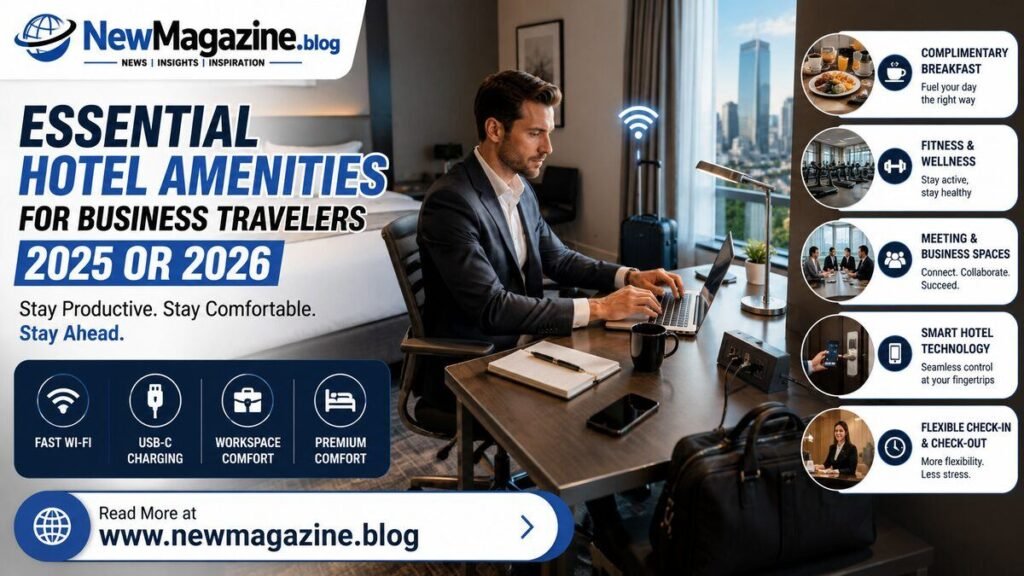
Hotel Amenities for Business travelers have different priorities from vacation guests. A leisure traveler may care heavily about a pool, entertainment, or sightseeing access, while a professional on a short work trip may prioritize fast internet, a comfortable desk, quiet surroundings, breakfast, transportation, and the ability to check in or out around an unpredictable schedule. Recent research confirms that location, employer policy, and cost remain major factors when business travelers select hotels. In BCD Travels 2025 survey, location was cited by 77% of respondents, while employer policy and cost were also major considerations.
Hotels Are Becoming Temporary Workspaces
The modern business hotel is increasingly expected to support productivity. A room may need to accommodate video meetings, email, presentations, financial work, research, calls, and other professional tasks. Research published in 2026 highlights ergonomic workspaces, quality sleep, climate control, reliable Wi-Fi, and technology enabled services as important elements of the modern business traveler experience. This means that hotels competing for corporate guests should think beyond traditional luxury. A beautiful lobby is useful, but a stable internet connection and a comfortable desk can have a much greater effect on a business travelers experience.
Reliable High Speed Wi-Fi
Fast, reliable Wi-Fi is arguably the most essential hotel amenity for business travelers in 2025 and 2026. Professionals may depend on hotel internet for video conferences, cloud applications, email, file transfers, customer calls, virtual presentations, and access to company systems. BCD Travels 2025 survey found that Wi-Fi was used by 88% of business travelers, making it the most frequently used hotel amenity in the survey. At the same time, 51% identified slow Wi-Fi as a source of frustration.
Speed Is Not Enough
Hotels should provide more than a network that technically connects. Business travelers need stable connectivity during peak periods, sufficient bandwidth for video calls, secure connections, and consistent coverage throughout guest rooms and work areas. A connection that works well at midnight but becomes unreliable during business hours does not meet the needs of corporate guests. Hotels should also clearly communicate whether Wi-Fi is complimentary, whether premium speeds cost extra, and whether conference rooms have dedicated high speed connections.
Wi-Fi Should Be Treated Like a Utility
For frequent business travelers, internet access is increasingly closer to a basic requirement than an optional amenity. A 2025 Cox Business survey found that 58% of surveyed Gen Z and millennial travelers considered fast, reliable hotel technology important, while connectivity problems were among their leading travel frustrations. For hotel operators, this creates a simple lesson: unreliable Wi-Fi can undermine an otherwise excellent property.
Dedicated In Room Workspace
A dedicated workspace is another essential hotel amenity for business travelers. A professional who has to prepare a presentation, answer emails, attend a video meeting, or work late at night needs more than a small decorative table. An appropriate desk, comfortable chair, adequate lighting, and accessible power outlets can make a significant difference.
Ergonomic Desk and Chair
An ergonomic chair is particularly valuable for guests who may spend several hours working. The desk should provide enough surface area for a laptop, notebook, phone, and other equipment without forcing the guest to work from the bed. A 2026 overview of business traveler preferences specifically identifies ergonomic workspaces as part of the functional hotel environment corporate guests increasingly expect.
Proper Lighting
Good lighting matters for both productivity and video calls. Business travelers may work early in the morning or late at night, making adjustable desk lighting especially useful. Natural daylight is also valuable, but it should be complemented by effective artificial lighting. Hotels can make a relatively simple improvement by ensuring that work areas have dedicated lighting rather than relying entirely on ambient room lighting.
Convenient Charging and Power Outlets
Modern professionals often travel with multiple devices. A typical business traveler may carry a laptop, smartphone, smartwatch, tablet, headphones, portable battery, and other equipment. That makes accessible power outlets one of the most practical hotel amenities.
Power Near the Bed and Desk
The most useful configuration places power outlets near both the workstation and the bed. Guests should not have to move furniture or crawl behind a nightstand to charge a phone. USB A and USB C charging options can add further convenience, although travelers should still carry their own compatible chargers.
Wireless Charging and Smart Connectivity
Wireless charging pads can be an attractive extra feature, particularly in higher end hotels. Smart desks, integrated USB C outlets, HDMI connectivity, and easy device pairing can also help turn a guest room into a functional temporary office. The important principle is simplicity. Technology should make the stay easier rather than forcing guests to learn a complicated system.
Comfortable Beds and Quiet Rooms
Productivity depends heavily on sleep. A business traveler who attends meetings all day and then works in the evening needs a comfortable place to recover. An uncomfortable mattress, excessive hallway noise, poor temperature control, or street noise can negatively affect the next days performance. BCD Travels 2025 research found that uncomfortable beds were one of the most frequently reported hotel frustrations, alongside dated rooms and breakfast not being included in the rate.
Quietness Matters
A quiet room can be more valuable to a business traveler than an elaborate decorative feature. Hotels can improve the experience through sound insulation, room placement away from elevators, effective doors, and thoughtful building design. Travelers should consider requesting a quiet room away from elevators, conference spaces, nightlife areas, and busy streets when booking.
Quality Sleep Supports Productivity
Hotels should view sleep quality as part of the business travel experience rather than simply a hospitality feature. Comfortable mattresses, blackout curtains, climate control, quality bedding, and quiet surroundings help travelers recover between demanding workdays.
Breakfast and Convenient Dining
Breakfast remains one of the most important amenities for business travelers. BCD Travels 2025 survey found that 80% of respondents used hotel breakfast, making it the second most used amenity after Wi-Fi. Meanwhile, 41% identified breakfast not being included in their hotel rate as a frustration.
Fast Breakfast Options
Business travelers often have limited time. A hotel breakfast should therefore offer quick, practical choices such as coffee, fruit, yogurt, eggs, oatmeal, cereals, and grab and go options. A breakfast that begins too late may be less useful to a traveler with an early meeting or airport departure.
Healthy Food Choices
Health conscious food options are increasingly relevant. Business travelers may spend several consecutive days away from home, making nutritious meals useful for maintaining energy and concentration. Hotels can provide healthier breakfast options, salads, fresh fruit, protein rich meals, and convenient snacks without sacrificing speed.
Flexible Check In and Check Out
Business travel rarely follows a perfect schedule. Flights can arrive late, meetings can run long, and transportation disruptions can change plans. Flexible check in and check out can therefore be highly valuable. BCD Travels 2025 research found that 47% of respondents used early check in or late check out services, demonstrating that schedule flexibility is an important hotel service for business guests.
Early Check In
Early arrival can create a problem if a traveler has nowhere to work or rest before a meeting. Hotels that provide early check in when rooms are available can significantly improve the guest experience. Even when an early room is unavailable, offering luggage storage, a business lounge, Wi-Fi, and a comfortable workspace can provide a practical alternative.
Late Check Out
Late meetings and evening flights make late check-out equally useful. A business traveler may need somewhere to shower, change clothes, finish work, or make calls before leaving for the airport. Flexible policies can therefore create meaningful value without requiring hotels to add an entirely new facility.
Business Centers and Meeting Spaces
Business centers remain useful, although their role has changed. In previous years, travelers might have depended on hotel business centers for printing, computers, faxing, and basic internet access. Today, many travelers carry their own devices, so the most useful business facilities are increasingly meeting rooms, quiet work areas, printing support, and reliable connectivity.
Meeting Rooms
A private meeting room can be valuable when a guest needs to meet clients, colleagues, or partners. Hotels located near business districts can benefit from offering flexible meeting spaces that can be booked by the hour rather than requiring large conference commitments.
Printing and Office Support
Printing may not be used every day, but it remains valuable when needed. Hotels can provide self service printing, scanning, copying, document delivery, and basic office supplies. These services can prevent a small problem from becoming a major inconvenience before an important meeting.
Fitness and Wellness Facilities
Business travel can disrupt normal health routines. Long flights, restaurant meals, meetings, and irregular schedules can make it difficult for travelers to exercise or maintain healthy habits. As a result, fitness and wellness amenities have become increasingly relevant. BCD Travels research identifies fitness centers and wellness features among amenities valued by business travelers.
Fitness Centers
A clean, accessible gym allows guests to exercise without leaving the hotel. The most useful business hotel fitness centers do not necessarily need to be enormous. Good cardio equipment, weights, stretching space, towels, water, and convenient opening hours can be enough.
Wellness Amenities
Higher-end properties can offer additional wellness services such as pools, spas, meditation areas, healthy dining, or in room fitness equipment. The goal is to help travelers maintain their routines while away from home.
Laundry and Garment Services
Laundry and garment services become particularly important during longer business trips. A professional attending several meetings may need clean shirts, suits, dresses, or other business clothing without having access to a washing machine.
Same Day Laundry
Same day or express laundry can be extremely valuable for corporate guests. The service can eliminate the need to locate an outside laundry provider and reduce the amount of clothing travelers need to pack.
Ironing and Garment Preparation
An iron, ironing board, steamer, or professional pressing service can help travelers prepare for important meetings. These services may seem basic, but they can become critical when someone has a presentation, interview, conference, or client meeting the next morning.
Smart Room and Mobile Technology
Technology is becoming an increasingly visible part of hotel stays. Business travelers increasingly expect convenient digital interactions, including mobile check in, digital room access, smart controls, and technology that reduces unnecessary waiting. A 2026 business travel trends overview identifies AI driven travel tools and biometric or contactless technologies among developments influencing the sector.
Mobile Check In and Digital Keys
Mobile check in can save time after a long flight. Digital room keys can similarly reduce friction, particularly when integrated into a hotel app. However, hotels should maintain traditional alternatives for guests who prefer physical keys or experience technical problems.
Smart Room Controls
Smart thermostats, lighting controls, curtains, and entertainment systems can improve convenience. The technology should remain intuitive. A guest should be able to adjust temperature and lighting without needing technical assistance.
Strong Mobile Connectivity
Hotel Wi-Fi is important, but mobile connectivity matters too. A business traveler may need to make calls, receive authentication codes, access mobile applications, or continue working while moving between the airport, hotel, client offices, and restaurants.
Reliable Cellular Coverage
Hotels should consider whether guest rooms and meeting spaces have reliable cellular coverage. Poor reception can become especially problematic when Wi-Fi authentication fails or when a traveler needs to make an urgent phone call.
Backup Connectivity
Strong mobile coverage also provides redundancy. If hotel Wi-Fi experiences a temporary problem, a guest with reliable cellular service can use a hotspot and continue working.
Safety and Security
Safety is a fundamental hotel requirement for business travelers. A 2025 BCD Travel survey found that around 30% of business travelers reported feeling unsafe in their hotel location, demonstrating that location security remains a meaningful consideration.
Secure Access
Hotels should provide controlled access to guest floors, secure entrances, functioning room locks, and adequate lighting. Modern access systems can use mobile keys, electronic locks, cameras, and controlled elevators, but traditional security measures remain essential.
Safe Surroundings
A hotel’s internal security is only part of the equation. Business travelers also care about the surrounding neighborhood, transportation options, proximity to offices, and how easy it is to return to the hotel after evening meetings.
Convenient Hotel Location
Location remains one of the strongest hotel selection factors for business travelers. BCD Travels research found that 77% of respondents considered location when selecting hotels, making it one of the most important decision criteria.
Proximity to Business Districts
A hotel close to offices, conference centers, corporate campuses, or event venues can save significant time. A slightly more expensive room may actually be more economical if it eliminates long taxi rides or daily commuting.
Airport and Transportation Access
Airport access can also matter, particularly for short business trips. Hotels near public transportation, rail stations, airports, and major roads can make business travel substantially easier.
Parking and Transportation Services
Parking remains useful for business travelers who rent cars or drive to meetings. A hotel should clearly communicate whether parking is complimentary, paid, valet only, or subject to availability.
Airport Transfers
Airport shuttle services can simplify arrivals and departures. Hotels that provide reliable transportation should clearly publish schedules, pickup points, costs, and booking requirements.
Ride Hailing and Local Transportation
Business travelers also benefit from easy access to taxis, ride hailing services, public transportation, and car rental facilities. A concierge or digital hotel guide can help guests understand local transportation options without wasting time researching them independently.
Loyalty Programs and Corporate Rates
Loyalty programs are another important consideration. BCD Travels 2025 research found that 80% of business travelers belonged to at least one hotel loyalty program, while many frequently chose properties associated with their preferred programs.
Loyalty Benefits
Useful loyalty benefits can include room upgrades, late check out, breakfast, bonus points, preferred rooms, and faster service. For frequent travelers, these benefits can accumulate into significant value over time.
Corporate Rates
Companies may also negotiate corporate hotel rates. A good corporate program can provide predictable pricing, flexible policies, preferred amenities, and consistent standards across destinations.
Sustainable Hotel Amenities
Sustainability is becoming more visible in corporate travel policies, although traveler behavior does not always match stated environmental preferences. BCD Travels 2025 research found that many business travelers still rarely consider sustainability when booking hotels, while only a minority actively check certifications or environmental measures.
Practical Sustainability
Useful sustainable hotel amenities can include refillable water stations, energy efficient lighting, recycling, water saving fixtures, reduced single use plastics, and responsible housekeeping programs. These features can reduce environmental impact without compromising comfort.
Sustainability and Corporate Travel
Sustainability may become more important as companies strengthen environmental reporting and travel policies. Current 2026 business travel trends point toward greater attention to ESG, carbon tracking, and environmentally conscious travel decisions. For hotels competing for corporate contracts, credible sustainability practices may therefore become increasingly relevant.
Amenities for Extended Business Trips
Longer assignments require different amenities from overnight stays. A professional staying for a week or more may value kitchen facilities, laundry access, larger rooms, storage space, work areas, and comfortable common spaces.
Kitchen and Food Preparation
Kitchenettes or in room refrigerators can be particularly useful during extended stays. They allow travelers to store food, prepare simple meals, and reduce dependence on restaurants. BCD Travels 2025 research also found that apartments can appeal to travelers on longer trips because they provide additional space, meal preparation options, and laundry facilities.
Comfortable Living Space
A larger room can become important during an extended assignment. A guest who spends several hours working, eating, relaxing, and sleeping in the same room benefits from clear separation between work and rest areas.
Bleisure Friendly Hotel Features
The line between business and leisure travel continues to evolve. In 2026, business travel trends increasingly include bleisure, where professionals combine work trips with personal leisure time.
Leisure Facilities
A pool, fitness center, restaurant, bar, rooftop space, or nearby attractions can make a hotel more appealing when travelers extend a work trip. These amenities may not be essential for a one night business stay, but they can influence the decision when a traveler plans to stay through a weekend.
Flexible Stay Options
Hotels can support bleisure travel with flexible room availability, extended stay options, luggage storage, and easy access to local attractions. This gives business travelers more freedom without sacrificing professional convenience.
Latest Hotel Amenity Trends for Business Travelers
The hotel experience is changing as business travel evolves. In 2026, technology, wellness, sustainability, flexibility, and personalization are becoming more prominent. A recent 2026 analysis from Mews identifies reliable Wi-Fi, ergonomic workspaces, quality sleep, climate control, mobile check in, smart room controls, and loyalty benefits as important elements of the modern business traveler experience.
AI and Personalized Travel Experiences
AI is increasingly influencing travel planning and hotel technology. The Global Business Travel Association reported in 2026 that corporate travel buyers showed strong demand for AI, while fragmented technology and inconsistent traveler experiences remain challenges. For hotels, this could mean more personalized recommendations, automated service requests, smarter booking experiences, and better integration between hotel systems and corporate travel platforms.
Quiet and Private Spaces
Another emerging theme is the value of privacy and quiet. Hiltons 2026 trends research highlights a growing desire for solitude and describes guest rooms as spaces where travelers can work, relax, stream entertainment, or simply disconnect. For business hotels, this reinforces an important idea productivity does not always require a crowded business center. Sometimes the best business amenity is a quiet, comfortable room.
How Business Travelers Should Evaluate Hotel Amenities
A hotel should not be judged simply by the number of amenities listed on its website. The important question is whether the amenities actually support the purpose of the trip.
Prioritize Your Work Requirements
If you have video meetings, prioritize Wi-Fi, workspace, power outlets, and quietness. If you have early meetings, breakfast hours and transportation may matter more. If you are staying for two weeks, laundry and kitchen facilities become considerably more important.
Check the Details Before Booking
Hotel booking pages can use broad descriptions such as business friendly or high speed Wi-Fi. Travelers should investigate what those terms actually mean. Look for details about internet availability, desk size, breakfast hours, parking fees, check in flexibility, meeting rooms, fitness facilities, and transportation.
Reviews and Business Traveler Expectations
Hotel reviews can reveal problems that official property descriptions may not mention. Recent guest reviews can help identify recurring issues involving Wi-Fi reliability, noise, uncomfortable beds, outdated rooms, parking, breakfast, and customer service.
What to Look For in Reviews
Don’t focus exclusively on the overall star rating. Search reviews for specific terms such as Wi-Fi, desk, workspace, noise, breakfast, outlets, business, conference, parking, check in, and room service. This can reveal whether the hotel’s advertised amenities actually perform well.
Recent Reviews Matter Most
Hotel conditions can change. A property may have renovated rooms, upgraded Wi-Fi, changed management, or introduced new services since older reviews were published. For that reason, recent reviews are generally more useful when evaluating a hotel for an upcoming business trip.
Stay Connect With Us
Conclusion
The essential hotel amenities for business travelers in 2025 and 2026 are increasingly centered on productivity, connectivity, comfort, flexibility, and convenience. The traditional expectation of a clean room and comfortable bed remains important, but todays professional traveler often needs something closer to a temporary office and recovery space. Reliable Wi-Fi, a proper workspace, accessible charging, comfortable bedding, quiet rooms, breakfast, flexible check in and check out, fitness facilities, convenient transportation, and strong security should be considered core business hotel features rather than optional extras.
Recent BCD Travel research reinforces this priority, with Wi-Fi and breakfast ranking as the most used hotel services and slow Wi-Fi emerging as the leading source of frustration. At the same time, the business travel experience is becoming more technology driven and personalized. Mobile check in, smart rooms, AI enabled travel tools, sustainability initiatives, loyalty benefits, and bleisure friendly services are shaping expectations in 2026.
For travelers, the best hotel is therefore not necessarily the property with the most amenities. It is the hotel that provides the right amenities for the purpose of the trip. A one night executive visit may prioritize Wi-Fi, location, breakfast, and late check out, while a two week assignment may make laundry, kitchen facilities, fitness, workspace, and storage much more important. For hotel operators, the message is equally clear business travelers value functionality. Investing in reliable connectivity, comfortable workspaces, flexible service, quality sleep, and practical technology can create a stronger guest experience and help hotels compete for the growing corporate travel market.
Do Not Miss Our
Frequently Asked Questions
What are the most important hotel amenities for business travelers?
The most important amenities generally include reliable high speed Wi-Fi, a comfortable workspace, accessible power outlets, quality bedding, quiet rooms, breakfast, flexible check in and check out, and convenient transportation. BCD Travels 2025 survey found Wi-Fi and breakfast were the two most used hotel services among business travelers.
Is free Wi-Fi essential for business travelers?
Yes. Reliable Wi-Fi is one of the most important hotel requirements for professionals who need to work remotely, attend video meetings, communicate with clients, or access cloud based systems. In the BCD Travel survey, 88% of business travelers used hotel Wi-Fi, while slow Wi-Fi was the most frequently reported hotel related frustration.
Do business travelers need a hotel business center?
Not necessarily. A dedicated business center is useful, but a well designed in room workspace with reliable Wi-Fi, power outlets, and comfortable seating may be more valuable for many modern travelers. Meeting rooms, printing, scanning, and private workspaces can still be important for professionals with client meetings or presentations.
Is breakfast important for business travelers?
Yes. Breakfast is one of the most frequently used hotel amenities among business travelers. BCD Travel found that 80% of surveyed business travelers used breakfast, while 41% reported frustration when breakfast was not included in their hotel rate.
What technology should a business hotel provide?
Useful hotel technology includes fast Wi-Fi, mobile check in, digital keys, USB C charging, smart room controls, convenient device connectivity, and reliable cellular coverage. Technology should be intuitive and should reduce friction rather than make the guest experience more complicated.
Are fitness centers important in business hotels?
Fitness facilities are valuable because business trips can disrupt normal exercise routines. A clean gym with cardio equipment, weights, stretching space, towels, and convenient hours can be particularly useful for frequent business travelers.
Should business travelers care about hotel sustainability?
Sustainability is becoming increasingly relevant to corporate travel programs, although individual traveler behavior varies. Companies may increasingly consider environmental performance, carbon emissions, certifications, energy use, and sustainable operations when selecting preferred hotel suppliers.
What should I check before booking a hotel for a business trip?
Check Wi-Fi quality, workspace, power outlets, room quietness, breakfast hours, location, transportation, parking, check in and check out policies, fitness facilities, reviews, and the total price. For longer stays, also consider laundry, refrigerator or kitchen facilities, storage, and living space.