
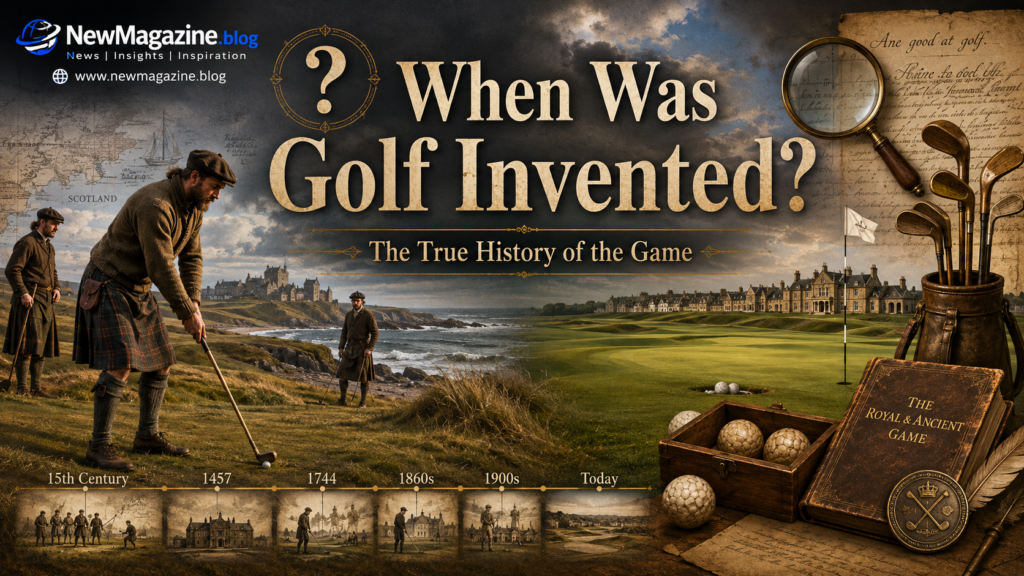

When Was Golf Invented? The True History of the Game
If you have ever wondered when was golf invented, the simplest answer is that the modern form of golf developed in Scotland during the Middle Ages, with written evidence showing that the game was being played there by the fifteenth century.
However, the complete answer is more interesting. Golf was not necessarily invented by one person on one specific day. Games involving a ball, a stick, and a target existed in different forms across Europe and other parts of the world long before golf developed into the sport recognized today.
What makes Scotland especially important is that the game played there developed characteristics that became closely associated with modern golf. Players used clubs to strike a ball toward a target or hole, played over open landscapes, and gradually developed traditions, courses, clubs, and rules that helped transform a recreational activity into an organized sport.
Today, golf is played by millions of people around the world. Professional tournaments attract international audiences, famous courses have become major sporting landmarks, and the game has developed into a global industry. Yet the question when was golf invented? still leads back to the windswept landscapes of medieval Scotland.
What Is Golf and Where Did It Begin?
Golf is a sport in which players use clubs to hit a ball toward a series of holes using as few strokes as possible. Modern golf has standardized rules, specialized equipment, professionally designed courses, and organized competitions.
The basic idea sounds simple, but the history behind the game is complex. The modern version of golf developed gradually rather than appearing suddenly as a completely finished sport.
The Basic Idea Behind the Game
At its core, golf belongs to a broad family of stick and ball games. Human societies have played games involving striking objects with sticks, clubs, or other tools for centuries.
What makes golf distinctive is its objective. Instead of simply hitting a ball as far as possible or toward another player, golf developed around the challenge of guiding a ball toward a specific destination and eventually into a hole.
This combination of skill, landscape, strategy, and competition helped give golf its unique identity.
Why Scotland Is Considered the Birthplace of Modern Golf
Scotland is widely regarded as the birthplace of modern golf because the strongest historical evidence connecting the game to its recognizable form comes from there.
By the fifteenth century, Scottish records already mentioned a game called golf. Over time, Scottish communities developed courses, playing traditions, equipment, and eventually formal organizations that shaped the sport.
While earlier games may have shared similarities with golf, Scotland played the central role in developing the version that became the foundation of the modern game.
When Was Golf Invented?
There is no universally accepted single date when golf was invented. Historians generally avoid assigning the sport to one inventor or one exact year because the game evolved over time.
The earliest widely recognized written evidence of golf in Scotland dates to 1457, when the Scottish Parliament banned the playing of golf because authorities believed it was distracting people from practicing archery.
The Earliest Documented Evidence of Golf in Scotland
The famous 1457 reference is important because it proves that golf was already established enough to attract the attention of the government.
A law does not usually ban a completely unknown activity. The fact that Scottish authorities specifically mentioned golf suggests that people were playing it frequently enough for the activity to be considered a problem.
This is why 1457 is often mentioned when answering the question when was golf invented, even though it should be understood as the date of an important written record rather than the exact moment golf began.
Why There Is No Single Invention Date
Many sports developed gradually from earlier games. Rules changed, equipment improved, and local traditions became more standardized over generations.
Golf followed this pattern. The game played in fifteenth century Scotland was not identical to the highly regulated professional sport seen today.
The modern game is therefore the result of centuries of development rather than the invention of a single individual.
Early Games That May Have Influenced Golf
The question of golf’s origins has inspired considerable historical debate. Several older games involved striking a ball with a stick or club toward a target.
These similarities have led some researchers to investigate whether golf may have been influenced by earlier activities in Europe or elsewhere.
Stick and Ball Games in Medieval Europe
Medieval Europe included numerous games involving balls and striking instruments. Different regions developed their own traditions, often with local rules that were never formally recorded.
Some historians have discussed games played in the Netherlands, France, and other European areas because they involved hitting a ball toward a destination.
However, similarity does not necessarily prove direct ancestry. Many games can independently develop comparable mechanics.
The Debate Surrounding Dutch, French, and Other Early Games
A Dutch game known as kolf is often discussed in conversations about the origins of golf. Players used a stick or club to strike a ball toward a target.
Other European games also shared some features with golf. These historical connections remain interesting, but the existence of an earlier stick and ball game does not automatically mean it became modern golf.
The strongest historical case for the development of the modern sport still centers on Scotland.
The Scottish Origins of Modern Golf
Scotland provided the environment in which golf developed into something increasingly recognizable as the modern game.
The countrys coastal landscapes, particularly areas known as links land, became naturally suited to a game played across open terrain.
Golf in Fifteenth Century Scotland
By the fifteenth century, golf was already known well enough to appear in official records. Players apparently spent enough time playing that government authorities worried about its effect on military preparedness.
At the time, archery was considered an important national skill. Authorities wanted citizens to practice archery rather than recreational activities such as football and golf.
This historical context makes the famous ban particularly valuable to historians.
The Famous Ban on Golf
The Scottish government banned golf in 1457, associating it with activities that distracted citizens from archery practice.
The ban was repeated in later years, indicating that golf continued to be played despite official restrictions.
Ironically, the attempts to suppress golf created some of the earliest surviving written evidence proving that the game existed.
How Golf Became an Organized Sport
Over time, golf moved from a relatively informal recreational activity toward a more organized sport.
As communities established regular playing areas, traditions gradually became more consistent. Players also began forming clubs and organizing competitions.
From Informal Games to Established Rules
Early golf did not have the detailed rulebook familiar to modern players. Local customs likely varied from place to place.
As the game became more popular, golfers needed shared expectations about scoring, equipment, competition, and course play.
This gradual process of standardization helped transform golf into a sport that could be played competitively across different locations.
The Growth of Golf Clubs and Competitions
Golf clubs played a major role in organizing the sport. They brought players together, established traditions, and helped formalize competitive play.
The growth of organized clubs also helped spread ideas about rules and etiquette.
Eventually, golf became more than a local pastime. It developed institutions capable of influencing how the sport was played far beyond Scotland.
St Andrews and the Development of Golf
No discussion of golf history is complete without mentioning St Andrews. Located in Scotland, St Andrews became one of the most important places in the development of the sport.
Its historic links are closely connected to golf’s traditions and global identity.
Why St Andrews Became So Important
Golf was played at St Andrews for centuries, and the town eventually became associated with many of the games most influential traditions.
The Old Course at St Andrews is widely regarded as one of the world’s most historic golf courses.
Its landscape, architecture, and long connection with the game helped establish St Andrews as a symbolic center of golf.
The Evolution of the Golf Course
Early golf courses were very different from modern, professionally engineered facilities. Natural landscapes often shaped the routes players followed.
Sand dunes, uneven ground, natural grasses, and changing weather conditions created challenges.
Over time, course design became more specialized, but many modern courses still preserve the strategic principles that developed on Scotlands historic links.
The Development of Golf Equipment
Golf equipment has changed dramatically since the games earliest days. Modern players benefit from advanced materials, precision engineering, and specialized club designs.
Early golfers used much simpler equipment.
Early Wooden Clubs and Handmade Balls
The earliest golf clubs were generally made from wood. Different clubs gradually developed for different types of shots.
Golf balls also evolved over time. Early versions were handmade and could vary in quality and performance.
The technology available to players had a major influence on how far they could hit the ball and how courses were designed.
Changes That Transformed the Game
Advances in golf ball technology and club construction made the sport more accessible and more competitive.
Improved equipment allowed players to achieve greater distance and consistency.
These changes also forced golf courses to adapt. As players became capable of hitting the ball farther, architects developed new challenges to preserve strategy and skill.
How Golf Spread Around the World
Golf began as a game strongly associated with Scotland, but its influence eventually spread internationally.
Trade, migration, military connections, and the expansion of the British Empire all contributed to golfs movement across borders.
Golf Beyond Scotland
Scottish golfers, workers, and enthusiasts introduced the game to other countries.
Golf clubs began appearing in England and eventually across Europe, North America, Asia, Africa, and other regions.
Each new location adapted the sport to local landscapes and cultures.
The Rise of International Competition
As golf became increasingly organized, national and international competitions gained popularity.
Professional tournaments created new opportunities for players to build careers, while major championships helped turn golf into a global spectator sport.
Today, international tours and major events feature players from many different countries.
Why Is the History of Golf Still Trending?
Questions about when golf was invented remain popular because the sport combines tradition with modern innovation.
People learning golf often become curious about its origins, while longtime fans may want to understand how ancient traditions connect to todays professional game.
Continued Curiosity About the Sports Origins
Historical questions are appealing because golfs past is filled with unusual stories. A government ban, centuries old courses, handmade equipment, and debates about the games true origins all make the subject engaging.
The fact that there is no single invention date also encourages discussion.
People searching for a simple answer often discover a much broader story.
Golf’s Cultural and Global Influence
Golf is now played across the world, but Scotland remains central to its identity.
Historic courses, traditional championships, and Scottish terminology continue to influence how the sport is understood.
This connection between local origins and global popularity keeps the history of golf relevant.
Latest Update on Golf History
Modern historical research continues to examine documents, archaeological evidence, and cultural traditions connected to the development of golf.
However, new research has not changed the central historical understanding that Scotland played the defining role in shaping the game recognized as modern golf.
What Historians Generally Agree On
Historians generally distinguish between earlier stick and ball games and the development of modern golf.
Earlier games may have shared similarities, but Scotland provides the strongest documented historical foundation for the sport’s recognizable traditions.
The written evidence from the fifteenth century remains one of the key reasons Scotland is considered the birthplace of modern golf.
Why New Research Can Refine Historical Understanding
History is not always fixed in the sense that new documents can provide additional context.
Researchers may discover previously overlooked records or develop new interpretations of existing evidence.
Even so, the discovery of an earlier ball and stick game would not necessarily replace Scotlands central role in the evolution of modern golf.
Reviews and Historical Perspectives
The history of golf has been reviewed and debated by historians, sports organizations, writers, and golf enthusiasts.
The main disagreement usually concerns how far back the sports origins should be traced.
The Debate Over Golfs True Origins
One perspective emphasizes that humans played similar games long before golf appeared in Scottish records.
Another focuses on the specific characteristics that distinguish modern golf from other stick and ball activities.
Both perspectives can contribute to a more complete understanding of the sport.
Why Scotland Remains Central to the Story
Even when historians acknowledge earlier games, Scotland remains the strongest candidate for the birthplace of modern golf.
The development of recognizable playing traditions, historic courses, clubs, and organized competition all contributed to this position.
In simple terms, golf may have distant relatives in older games, but the modern sport grew up in Scotland.
Stay Connect With Us:
Conclusion
So, when was golf invented? The most accurate answer is that modern golf developed in Scotland during the Middle Ages, with important written evidence showing that the game was already being played by 1457. The story does not begin and end with one date. Earlier stick and ball games existed in different cultures, and historians continue to debate whether any of them influenced golf’s development. Yet Scotland remains the central chapter in the history of the modern game. Its players, landscapes, links courses, clubs, traditions, and early rules helped transform a recreational activity into the international sport known today.
From medieval Scottish fields to famous championship courses around the world, golf has traveled an extraordinary distance. Understanding its origins makes the game more than a sport of clubs, balls, and scorecards. It becomes a story of history, culture, innovation, and centuries of human competition.
Frequently Asked Questions About When Golf Was Invented
When was golf invented?
Modern golf developed in Scotland during the Middle Ages. The earliest widely recognized written reference to golf dates to 1457.
Who invented golf?
There is no single person officially recognized as the inventor of golf. The game developed gradually over time through the traditions and practices of players, particularly in Scotland.
Was golf invented in Scotland?
Scotland is widely considered the birthplace of modern golf. Although earlier games in other countries shared similarities, the Scottish version developed into the sport that later spread around the world.
What was the first golf course?
The historic links at St Andrews in Scotland are among the oldest and most famous golf grounds in the world. St Andrews became especially important in the development of golf and remains strongly associated with the sports history.
Why was golf once banned?
Golf was banned in fifteenth century Scotland because authorities believed it distracted people from practicing archery. Archery was considered important for military preparedness, so recreational games were viewed as a problem.
When did modern golf rules develop?
Golf rules developed gradually as clubs and organized competitions became more common. Standardization increased as the sport grew, helping create consistent rules that could be used across different courses and competitions.
What Was Used Before Modern Golf Balls?
Early golf balls were handmade using materials and techniques available at the time. Golf ball technology changed significantly over the centuries, eventually leading to the highly engineered balls used by modern players.
How Did Golf Spread Internationally?
Golf spread from Scotland through migration, trade, military connections, and international cultural influence. Golf clubs and courses eventually appeared throughout Europe and other parts of the world, transforming the game into a global sport.