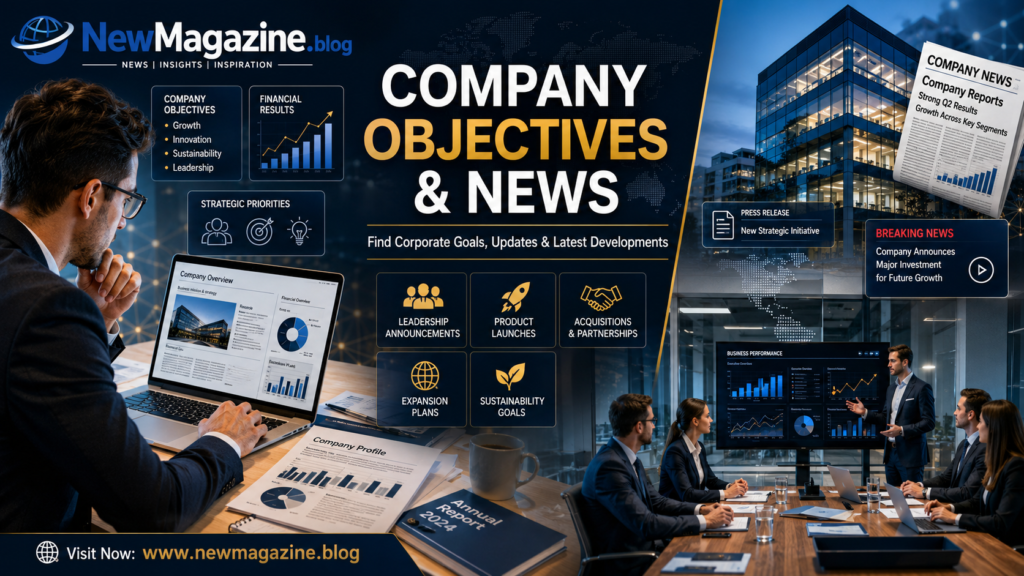

Whether you are prepping for a job interview, researching a potential investment, sizing up a competitor, or just trying to understand what a business actually does, knowing how to Get Any Company Objectives and News and current news matters more than most people realize. A single outdated blog post or an old About Us page won’t cut it company strategy shifts, leadership changes, and news moves fast.
This guide walks through exactly how to find accurate, current information on any company objectives and news, using the same research approach professionals rely on no guesswork, no relying on a single stale source.
To find a company objectives and recent news, start with primary sources the company own investor relations page, official press releases, and for public companies regulatory filings, then cross check with recent, dated news coverage from reputable outlets and a direct search for the company name plus news or announcement. Avoid relying solely on older blog posts, outdated About Us pages, or AI generated summaries without checking their source and date, since company objectives and leadership can change significantly year to year.
Key Facts Table
| Research Goal | Best Source Type |
|---|---|
| Company mission/objectives | Official “About” or investor relations page |
| Recent financial performance | Quarterly earnings reports, annual reports (10-K for U.S. public companies) |
| Leadership and executive changes | Company press releases, LinkedIn, business news outlets |
| Product launches or strategic shifts | Official press releases, company blog, industry trade publications |
| Legal or regulatory news | Regulatory filings (SEC EDGAR for U.S. public companies), court records, business news |
| General reputation and public sentiment | Review sites, social media, employee review platforms |
| Historical company background | Company website, Wikipedia (verify against primary sources), business databases |
Step 1: Start With the Company Own Official Sources
The most reliable starting point for understanding a company stated objectives is almost always the company it self. Most businesses maintain an About Us or Our Mission page that outlines their core purpose, values, and strategic priorities. For publicly traded companies, the investor relations section of the website typically goes much further, often including
Quarterly and annual earnings reports
Investor presentations that outline strategic priorities and growth plans
Shareholder letters, which frequently spell out leaderships stated objectives in detail
Press release archives covering major announcements
This is where you wiill find a company own framing of its goals useful, but worth remembering that it is inherently promotional. A company’s investor relations page will emphasize strengths and downplay challenges, which is exactly why the next steps matter just as much.
Step 2: Check Regulatory Filings for Publicly Traded Companies
If the company is publicly traded, regulatory filings offer some of the most rigorously accurate information available, since these documents carry legal accountability requirements that marketing materials don’t.
In the United States, the Securities and Exchange Commissions EDGAR database accessible at sec.gov hosts a company’s 10K annual reports, 10Q quarterly reports, and 8K filings for major events, all free and publicly searchable by company name or ticker symbol.
In other countries, equivalent regulatory bodies maintain similar filing systems for example, Companies House in the United Kingdom, or a country’s national securities exchange and its associated disclosure requirements.
These filings typically include a Managements Discussion and Analysis section, where company leadership directly explains recent performance, risks, and strategic direction in language that’s legally required to be more measured and accurate than promotional marketing copy.
Step 3: Search for Recent, Dated News Coverage
Once you understand a company’s own stated objectives, cross reference that against recent news coverage to see how those objectives are actually playing out. A few practical tips for this step:
Search the company name alongside specific, recent terms like news announcement, earnings, or the current year, rather than a generic company name search that may surface years old results first.
Filter search results by date whenever the search tool allows it, since company news changes fast and older articles can easily be mistaken for current information if you’re not paying attention to publication dates.
Prioritize established business news outlets sources like Reuters, Bloomberg, the Associated Press, or major national business publications tend to have stronger fact checking standards than lesser known blogs or aggregator sites.
Look for multiple independent sources reporting the same information, especially for significant claims like a merger, executive departure, or major financial result, since a single source repeating unverified information is a common way inaccurate claims spread.
Step 4: Use Company News Aggregators and Alerts
For ongoing monitoring rather than a one time research task, a few tools can help keep you updated on a company’s latest news without manually searching every day:
Google Alerts lets you set up free, automated email notifications whenever new content matching a company’s name is indexed.
Company press release distribution services, like PR Newswire or Business Wire, often let you search or subscribe to a specific company’s official press releases directly.
Financial news platforms with company specific news feeds, commonly available through major financial data sites, can be useful for anyone tracking a publicly traded company’s stock related news specifically.
LinkedIn company pages frequently post updates directly from the company it self, including leadership changes, product announcements, and major milestones, often before that information appears in traditional news coverage.
Step 5: Look Beyond the Company’s Own Narrative
A company’s official communications will always emphasize its strengths, so a complete picture requires looking at sources the company does not directly control
Employee review platforms like Glassdoor or Indeed can offer insight into internal company culture and how stated objectives align or don’t with day to day employee experience, though individual reviews should be read with the understanding that they reflect personal, sometimes emotionally charged experiences rather than comprehensive company-wide data.
Industry trade publications often cover a company’s strategic moves with more specialized, critical context than general business news, particularly for understanding how a company’s objectives compare to competitors within its specific industry.
Analyst reports and earnings call transcripts, for publicly traded companies, often include direct questions from financial analysts that push company leadership to clarify or defend their stated objectives in ways a press release never would.
Court records and regulatory actions, where relevant, can reveal significant information about a company’s legal or compliance history that would not appear in standard news coverage or company materials.
What to Watch Out For When Researching Company Information
A few common pitfalls can lead to inaccurate or outdated conclusions about a company’s objectives or recent news
Outdated About Us pages. Many companies don’t update their general mission statement pages as frequently as their actual strategic priorities shift, meaning a company’s public facing mission language can lag behind its real current direction.
Unverified secondhand summaries. Content that summarizes what a company is doing without linking back to a primary source or dated original reporting should be treated with caution, since errors and outdated information tend to compound as content gets recirculated and rewritten across multiple sites.
Confusing a subsidiary with a parent company, or vice versa. Large corporate structures can make it easy to misattribute news or financial results to the wrong entity within a corporate family, particularly for companies that have gone through mergers, acquisitions, or rebranding.
Treating AI-generated summaries as a final source. AI tools, including this kind of research assistance, can help synthesize and organize information quickly, but any output should be checked against original, dated sources before being treated as confirmed fact, particularly for time sensitive company news.
Ignoring publication dates entirely. A well written, seemingly authoritative article about a company current strategy may be several years old, describing objectives or leadership that have since changed substantially.
Timeline How Company Research Methods Have Evolved
Pre internet era Company research relied heavily on printed annual reports, industry directories, and financial news delivered through newspapers and specialized publications, often with significant delays between events and public reporting.
1990s 2000s The rise of the internet and early search engines made company websites and online news archives broadly accessible, though the sheer volume of unverified content also began creating new challenges around source reliability.
2000s 2010s Regulatory bodies like the SEC expanded free, searchable online filing databases, making primary source financial and strategic disclosures directly accessible to the public rather than requiring specialized financial data subscriptions.
2010s Social media platforms, particularly LinkedIn and Twitter now X, became significant channels for companies to announce news directly, often faster than traditional press release distribution.
2020s AI powered search and summarization tools began playing a larger role in company research, offering faster synthesis of scattered information while also introducing new risks around outdated training data and unverified claims if not paired with real time source checking.
Latest Trends in Company Research
Modern company research increasingly blends multiple source types rather than relying on any single method. A few current best practices reflect how the research landscape has shifted
Real time search tools that can verify current information against live web sources have become increasingly valuable, particularly given how quickly company leadership, financial results, and strategic priorities can change.
Cross referencing AI generated summaries against primary sources has become a standard practice for careful researchers, since AI tools are useful for organizing and synthesizing information quickly but can occasionally present outdated or unverified information as current fact if not specifically checked against dated, sourced material.
Direct company social media monitoring has become a meaningful supplement to traditional news coverage, since companies increasingly announce major updates directly to platforms like LinkedIn before that information is picked up by traditional press.
Specialized business intelligence platforms, which aggregate financial filings, news, and company data into unified dashboards, have become increasingly accessible to individual researchers and small businesses, not just large institutional investors.
Expert Analysis Why a Multi Source Approach Matters
Research and information literacy specialists consistently point to the same core principle when it comes to accurately understanding a company no single source tells the whole story.
Company provided information is inherently promotional. Even accurate company materials are curated to present the business favorably, which is why cross referencing against independent news coverage and, where applicable, regulatory filings, provides a more balanced picture.
News coverage can also carry its own biases or incomplete framing. A single news article, even from a reputable outlet, may emphasize one angle of a larger story, which is why checking multiple independent sources for significant claims remains good practice.
Regulatory filings offer accountability that other sources do not. Because filings like a 10-K carry legal consequences for inaccuracy, they tend to be among the most reliable sources available for publicly traded companies specifically, even though they can be denser and harder to read than a press release.
Timeliness matters as much as accuracy. A technically accurate but outdated piece of information about a company’s leadership or strategy can be just as misleading as an inaccurate one, which is why checking publication and filing dates should be a standard step in any company research process.
Public Reaction Why This Kind of Research Matters to People
Interest in effectively researching company information spans a wide range of practical, everyday situations
Job seekers preparing for interviews frequently cite thorough company research, including recent news and stated objectives, as a key differentiator that helps them ask more informed questions and demonstrate genuine interest during the hiring process.
Individual investors increasingly emphasize the importance of checking primary sources like earnings reports rather than relying solely on secondhand financial news summaries, particularly following instances where inaccurate or exaggerated claims about a company have spread quickly on social media before being corrected.
Small business owners and entrepreneurs researching potential competitors, partners, or clients often highlight the value of combining official company information with independent news coverage to get a realistic picture of a company’s actual current standing, rather than just its marketing narrative.
Journalists and content researchers regularly discuss the importance of verifying company claims against dated, primary sources, particularly given how quickly outdated or inaccurate information can spread once it has been repeated across multiple secondary sources.
Comparisons Source Types at a Glance
| Source Type | Reliability for Objectives | Reliability for Recent News | Limitations |
|---|---|---|---|
| Company’s own website/IR page | High (as stated intent) | Medium (self-reported, promotional) | Doesn’t include critical perspective |
| Regulatory filings (e.g., SEC EDGAR) | High | High | Dense, technical, limited to public companies |
| Established business news outlets | Medium-High | High | Coverage depth varies by company size |
| Trade publications | Medium-High | Medium-High | May require industry-specific access |
| Employee review platforms | Low-Medium | Low | Individual, potentially biased perspectives |
| General web search / aggregators | Variable | Variable | Requires careful date and source checking |
Myths vs Facts
Myth A company’s About Us page always reflects its current strategy.
Fact These pages are often updated infrequently and can lag well behind a company’s actual current strategic priorities.
Myth If multiple websites report the same company news, it must be accurate.
Fact Many websites republish or lightly rewrite the same original source without independent verification, so seeing the same claim repeated does not necessarily mean it has been separately confirmed.
Myth Regulatory filings are only useful for professional investors.
Fact Filings like SEC 10K reports are free, publicly searchable, and can be genuinely useful for anyone researching a publicly traded company’s real strategic priorities and financial health.
Myth AI tools can fully replace manual company research.
Fact AI tools can help organize and summarize information efficiently, but outputs should still be checked against original, dated, primary sources, particularly for time sensitive claims.
Myth Private companies don’t have any publicly available objective information.
Fact While private companies have fewer disclosure requirements than public ones, many still publish press releases, participate in industry press coverage, and maintain investor-facing materials if they have raised outside funding.
Stay Connect With Us
Conclusion
Finding accurate, current information about any company’s objectives and news is not about locating a single perfect source it is about combining several different types of information and checking them against each other. A company’s own materials tell you what it wants you to believe about itself; regulatory filings and independent news coverage help confirm what was actually happening. Whether you are prepping for an interview, evaluating an investment, or simply trying to understand a business better, that layered, multi source approach remains the most reliable way to separate a company’s current reality from outdated assumptions or one sided promotional framing.
Frequently Asked Questions
What’s the best way to Get Any Company Objectives and News?
Start with the company’s own “About Us” or investor relations page, then cross-reference with recent earnings reports or shareholder letters for publicly traded companies.
How can I find the most recent news about a company?
Search the company’s name alongside terms like “news” or the current year, filter by date where possible, and prioritize established business news outlets.
Are SEC filings useful for researching a company’s strategy?
Yes, particularly the “Management’s Discussion and Analysis” section of a 10-K annual report, which explains company performance and direction with legally required accuracy standards.
How do I stay updated on a company news over time?
Tools like Google Alerts, press release distribution services, and following a company’s official LinkedIn page can help you track new developments as they happen.
Can I trust a company own press releases?
Press releases are generally factually accurate but inherently promotional in framing, so it’s worth cross-referencing significant claims against independent news coverage.
What should I do if I find conflicting information about a company?
Check the publication dates of each source first, since conflicting information often reflects outdated versus current facts rather than a genuine factual dispute.
Is Wikipedia a reliable source for company research?
It can be a useful starting point and often links to primary sources, but claims should be verified against those underlying sources rather than treated as final on their own.
How do I research a private company that doesn’t file with regulators?
Rely more heavily on press coverage, industry trade publications, the company’s own official communications, and, where available, funding announcements or investor materials.
What’s the difference between a 10-K and a 10-Q filing?
A 10-K is a comprehensive annual report, while a 10-Q is a quarterly report covering a shorter, more recent period — both filed with the SEC by U.S. publicly traded companies.
How can I verify if company news I found online is still current?
Check the publication date, and if possible, search for more recent coverage of the same topic to confirm whether anything has changed since the original article was published.
Are employee review sites a good source for understanding a company’s real objectives?
They can offer useful context on internal culture, but individual reviews are subjective and shouldn’t be treated as a comprehensive or objective summary of company-wide reality.
What’s the fastest way to get an overview of a company before a job interview?
Review the company’s own recent press releases and mission statement, then search for recent news coverage from the past few months to understand its current priorities and any recent developments.
Should I rely on AI tools for company research?
AI tools can help synthesize information efficiently, but their output should be verified against original, dated primary sources, particularly for anything time sensitive.
How often do company objectives typically change?
This varies significantly by company and industry, but major strategic shifts often follow leadership changes, financial results, mergers, or significant market developments, making periodic re-checking worthwhile rather than treating any single research pass as permanent.
What’s the single best habit for researching any company accurately?
Cross referencing multiple source types company materials, regulatory filings where applicable, and independent, dated news coverage rather than relying on any single source alone.