
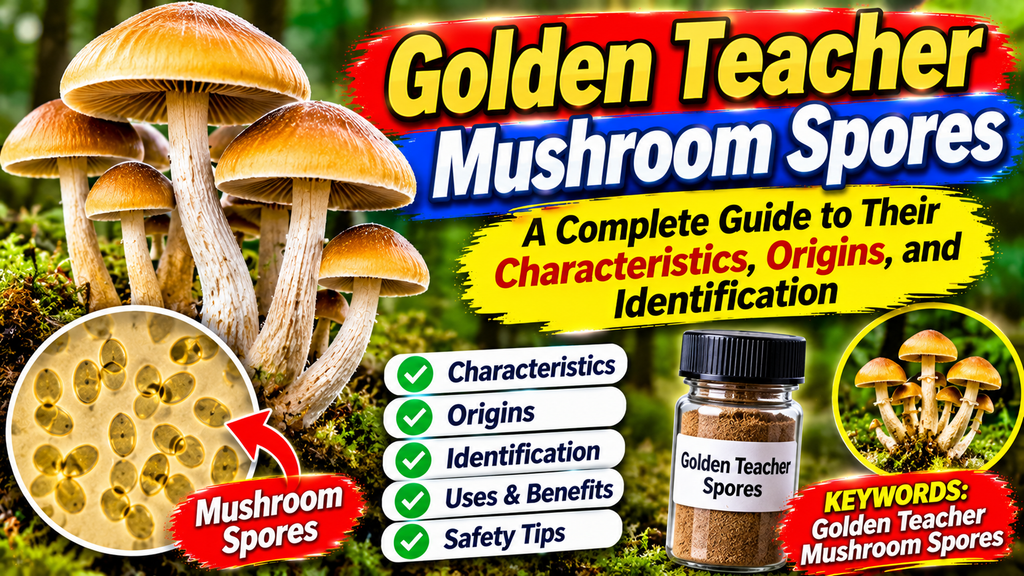

Introduction to Golden Teacher Mushroom Spores
Golden Teacher Mushroom Spores are widely discussed among mushroom enthusiasts, researchers, and people interested in mycology. Known for their distinctive golden-brown appearance and fascinating biological characteristics, Golden Teacher mushrooms have become one of the most recognized varieties associated with Psilocybe cubensis. Their name comes from their characteristic golden-colored caps and the curiosity they inspire among mushroom enthusiasts.
Golden Teacher mushrooms are particularly interesting because of their unique appearance, historical significance, and place in mushroom-related discussions. Understanding Golden Teacher mushroom spores involves learning about their biological characteristics, spore identification, storage considerations, legal status, and the importance of responsible research.
This article explores the essential information about Golden Teacher mushroom spores and explains why they remain a popular topic in mycology.
What Are Golden Teacher Mushroom Spores?
Golden Teacher mushroom spores are microscopic reproductive cells associated with the Golden Teacher variety of Psilocybe cubensis. Like other mushroom spores, they play an important role in fungal reproduction and biological diversity.
Spores are generally microscopic and are produced by mature mushrooms. They can be examined using appropriate laboratory equipment, particularly microscopes. In mycology, studying spores helps researchers understand fungal identification, classification, and reproductive processes.
Golden Teacher is a commonly recognized name within discussions of Psilocybe cubensis. However, the exact genetic characteristics of commercially described varieties can vary, and names used by different sellers are not always scientifically standardized.
History and Origins of Golden Teacher Mushrooms
Golden Teacher mushrooms became well known within modern mushroom culture because of their distinctive appearance and association with psychedelic mushroom research.
Although their precise origin is not firmly documented, they are generally discussed as a cultivated variety of Psilocybe cubensis. This species has a broad geographical distribution in tropical and subtropical environments.
Over time, Golden Teacher became a familiar name in online mycology communities, educational discussions, and mushroom identification resources.
Their popularity has also contributed to increased interest in fungal biology, microscopic spore examination, and the scientific classification of mushrooms.
Physical Characteristics of Golden Teacher Mushrooms
Golden Teacher mushrooms have several recognizable physical characteristics.
Some of their commonly described features include:
- Golden-colored caps: Their caps typically display yellowish or golden-brown shades.
- Distinctive appearance: Their overall shape resembles other members of the Psilocybe cubensis species.
- Central cap structure: Mature specimens can develop broad caps with a noticeable central shape.
- Microscopic spores: Their spores are microscopic reproductive structures.
- Dark spore prints: Mature mushrooms from this species generally produce dark purplish-brown spore deposits.
These characteristics make Golden Teacher mushrooms an interesting subject for fungal identification and scientific observation.
Golden Teacher Mushroom Spore Identification
Spore identification is an important part of mycology. Researchers often examine microscopic characteristics to distinguish different fungal species.
Golden Teacher spores are associated with the typical reproductive structures of Psilocybe cubensis. Their microscopic examination may involve observing features such as shape, color, and surface characteristics.
However, identifying a mushroom variety based only on spores can be difficult. Many fungal species share similar microscopic features.
Reliable identification generally requires considering several characteristics together, including:
- Microscopic spore morphology.
- Mushroom cap characteristics.
- Stem structure.
- Spore-print appearance.
- Additional scientific identification methods.
Accurate identification is especially important because some poisonous mushrooms can resemble other species.
Golden Teacher Mushroom Spores and Mycology Research
Mycology is the scientific study of fungi, including mushrooms, molds, and yeasts.
Golden Teacher mushroom spores are frequently mentioned in discussions about fungal reproduction and microscopic examination. Studying spores can help researchers understand how fungi reproduce, spread, and contribute to ecological systems.
Mycology research also explores the diversity of fungal species and their relationships with surrounding environments.
For educational purposes, examining fungal spores under a microscope can provide valuable information about fungal morphology and biological classification.
How Should Golden Teacher Mushroom Spores Be Stored?
Spore preservation is a subject of interest in fungal research and laboratory science. Environmental conditions can influence the stability of biological materials.
In general, laboratory preservation practices emphasize:
- Maintaining appropriate environmental conditions.
- Avoiding unnecessary contamination.
- Using suitable laboratory containers.
- Following applicable biological-material handling standards.
- Observing relevant storage and institutional safety guidelines.
Specific preservation requirements depend on the material and its intended scientific purpose.
It is also important to understand that possessing or storing spores may be subject to different legal requirements depending on the location.
Legal Considerations Regarding Golden Teacher Mushroom Spores
One of the most important considerations surrounding Golden Teacher mushroom spores is their legal status.
Golden Teacher is associated with Psilocybe cubensis, a species known for containing psilocybin and psilocin in its mature fruiting bodies.
The legal treatment of spores can differ from the legal treatment of mushrooms containing controlled substances. However, this distinction is not universal.
Some jurisdictions regulate spores, cultivation materials, possession, or activities associated with controlled mushrooms.
Before purchasing, possessing, researching, or transporting Golden Teacher mushroom spores, individuals should carefully review the laws applicable to their location.
Responsible research requires respecting local regulations and avoiding assumptions based on laws in other countries.
Differences Between Golden Teacher and Other Mushroom Varieties
Golden Teacher is one of several commonly discussed varieties associated with Psilocybe cubensis.
Different varieties may be described using names based on appearance, historical associations, or cultivation communities.
Some commonly discussed names include:
- Golden Teacher
- B+
- Ecuadorian
- Cambodian
- Mazatapec
These names are frequently used in enthusiast communities, but they do not necessarily represent formally recognized taxonomic classifications.
The differences between named varieties can involve appearance and reported genetic characteristics. However, reliable scientific comparisons require properly documented specimens and controlled research.
Safety and Responsible Mushroom Education
Learning about Golden Teacher mushroom spores should always involve responsible scientific education.
Wild mushroom identification can be challenging, and incorrect identification may result in serious poisoning. Visual similarities between mushroom species do not establish that a specimen is safe.
Additionally, psilocybin-containing mushrooms can produce powerful psychological effects and may cause adverse reactions.
People interested in mushroom science should prioritize:
- Scientific identification rather than assumptions.
- Reliable educational resources.
- Laboratory safety standards.
- Awareness of applicable laws.
- Avoiding consumption of unidentified mushrooms.
- Understanding the potential health risks associated with psychoactive fungi.
Responsible education helps people appreciate fungal biology without overlooking important safety considerations.
Why Are Golden Teacher Mushroom Spores Popular?
Golden Teacher mushroom spores attract attention for several reasons.
First, the Golden Teacher name is widely recognized in online mushroom communities. Second, the distinctive golden appearance associated with mature mushrooms makes the variety memorable.
Another important factor is growing public interest in mycology. More people are exploring fungal diversity, microscopic identification, mushroom ecology, and the scientific importance of fungi.
Educational resources and online discussions have also increased awareness of different mushroom varieties.
As a result, Golden Teacher remains a frequently discussed subject in mushroom-related research and educational content.
Conclusion
Golden Teacher mushroom spores are an interesting subject within modern mycology because of their association with Psilocybe cubensis, distinctive biological characteristics, and popularity in mushroom education.
Understanding their history, physical characteristics, microscopic identification, preservation considerations, and legal status provides a useful foundation for anyone interested in fungal science.
However, responsible research is essential. Accurate identification, awareness of potential health risks, and compliance with local regulations should always remain priorities.
Whether exploring fungal biodiversity or learning about microscopic reproductive structures, Golden Teacher mushroom spores offer an opportunity to better understand the fascinating biological world of fungi.