
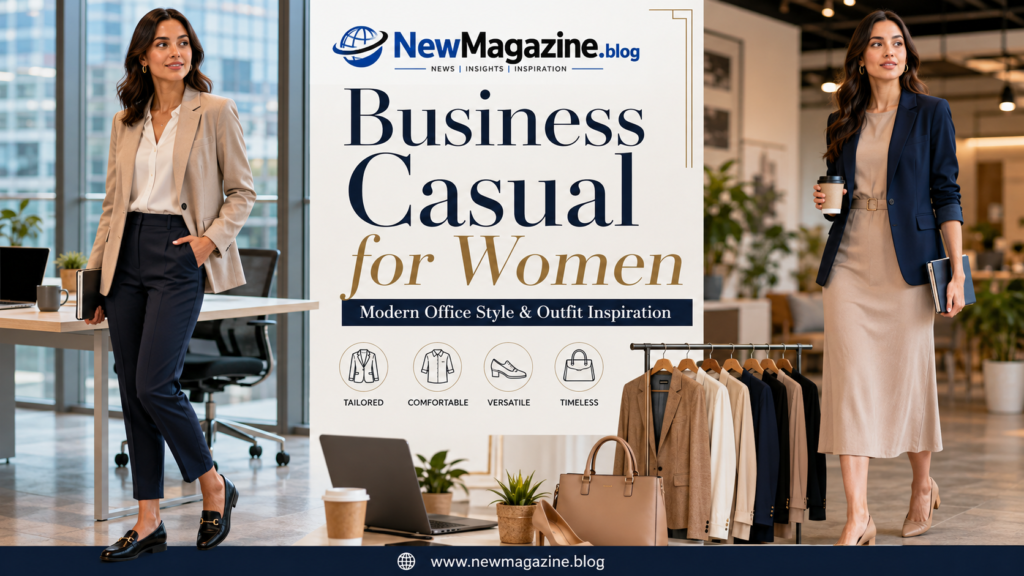

If you have ever stared into your closet the night before a first day of work, wondering whether business casual means blazer and trousers or cardigan and jeans, you are far from alone. It is consistently ranked as one of the most misunderstood dress codes in the modern workplace, and that confusion has only grown since hybrid work reshaped what people consider office appropriate.
This guide breaks down exactly what business casual for women actually means in 2026, the pieces worth building your wardrobe around, how the dress code has evolved, and where people most often get it wrong.
Business casual for women means professional, polished clothing that skips a full matching suit but still looks intentional and put together. Think tailored trousers or a pencil skirt paired with a blouse or fine knit sweater, finished with a blazer, cardigan, or structured jacket, and closed toe shoes like loafers, flats, or low heels. It sits between business formal matching suits, formal dresses and casual jeans, sneakers, T shirts. According to a 2026 workplace survey, business casual remains the most common workplace dress code, worn by roughly 41% of U.S. workers.
Key Facts Table
| Category | Detail |
|---|---|
| Definition | Professional attire without a full matching suit |
| Common pieces | Blazers, tailored trousers, pencil skirts, blouses, knit tops, midi dresses, cardigans, closed-toe flats or loafers |
| Generally avoided | Jeans (in most workplaces), sneakers, tank tops, flip-flops, athleisure, overly casual sandals |
| Prevalence | Roughly 41% of U.S. workers dressed business casual as of 2026 |
| 2026 defining trend | “Polished casual,” per trend forecaster WGSN — comfort dressing meets professional tailoring |
| Origin | Traces back to Aloha Friday (1960s Hawaii) and 1980s–90s tech-industry casual dress norms |
| Key distinction from smart casual | Business casual stays closer to traditional professional norms; smart casual allows more personal expression |
What Business Casual Actually Means for Women
At it was core, business casual is meant to strike a balance professional enough to walk into a client meeting, comfortable enough to get through a full workday without feeling stiff or overdressed. The confusion mostly comes from the name it self business suggests formality, while casual suggests the opposite, and different companies interpret that balance differently.
A useful way to think about it business casual should look deliberate, not thrown together. A blazer over a simple top reads as business casual. A hoodie under the same blazer does not. The goal is coordinated, well fitted separates rather than a matching suit professional without feeling like a courtroom appearance.
It is also worth understanding why this dress code exists in the first place, rather than companies simply choosing between formal and casual. Business casual emerged specifically as a middle ground meant to preserve a sense of professionalism and client readiness while acknowledging that employees do not need to be in a full suit to do focused, effective work. That is part of why the category tends to flex based on a company client interaction a role that regularly meets with clients or executives in person often skews toward the more formal end of business casual, while a role with mostly internal, behind the scenes work often has more room for relaxed interpretation.
Core Pieces Every Business Casual Wardrobe Should Have
Building a business casual wardrobe does not require reinventing your closet every season. A handful of well chosen staples can be mixed and matched into dozens of outfit combinations, which is generally a more sustainable and cost effective approach than buying entirely new outfits for each workday.
Tailored trousers. Straight leg or slightly wide leg trousers in neutral tones navy, black, gray, beige form the backbone of most business casual outfits.
A structured blazer. Arguably the single most versatile piece in the category. A well fitted blazer instantly elevates a simple blouse and trouser combination.
Blouses and fine knit tops. Silky blouses, structured button downs, and lightweight sweaters all work, as long as they avoid anything overly sheer, low cut, or casual in fabric.
A pencil skirt or midi skirt. A knee length or midi length skirt paired with tights or bare legs, depending on season, remains a classic business casual choice.
Cardigans and layering pieces. A well fitted cardigan can substitute for a blazer in more relaxed offices while still reading as intentional.
Closed toe flats, loafers, or low block heels. Footwear tends to be one of the most scrutinized parts of a business casual outfit comfortable but polished shoes work best.
A structured tote or work bag. Not strictly clothing, but a well chosen bag finishes the look and signals professionalism.
Prioritizing quality over quantity tends to pay off with these staples in particular. A handful of well fitted, durable pieces in versatile neutral tones will typically outlast and outperform, in terms of how put-together they look a larger wardrobe of lower quality items bought primarily for variety.
What to Avoid in a Business Casual Office
Just as important as knowing what to wear is knowing what typically crosses the line, even in more relaxed offices
Jeans, in most traditional business casual settings though some more casual workplaces have started to allow dark, structured denim.
Sneakers, unless your office has explicitly embraced them as part of a more relaxed dress code.
Tank tops, crop tops, or anything overly revealing, which typically reads as too casual or inappropriate for a professional setting.
Flip flops or overly casual sandals.
Wrinkled, stained, or visibly worn clothing one of the oldest and most consistent rules of business casual since the dress code first emerged in the 1990s.
Athleisure, including leggings worn as pants, sweatpants, or overly sporty outerwear.
That said, dress codes vary enormously by industry and company culture. A tech startup and a law firm may both call their dress code business casual while landing in noticeably different places on the formality spectrum which is part of why observing what colleagues actually wear during your first week at a new job is often more useful than any general guide.
It was also worth noting that avoid does not always mean never, under any circumstances. Company culture, regional norms, and even the specific days schedule a normal workday versus a big client presentation can shift what was considered acceptable. The safest strategy for anyone new to a role or workplace is to dress slightly more polished than the minimum for the first week or two, then calibrate down once you have a clear sense of how strictly or loosely the dress code is actually enforced day to day.
Seasonal Considerations for Business Casual
Business casual does not have to mean the same outfit formula year round. A few seasonal adjustments can keep the look both comfortable and appropriate, and they are often the difference between an outfit that photographs well for a video call but leaves you uncomfortable for an eight hour work day, versus one that actually holds up in practice.
Warmer months Lightweight blazers, short sleeve blouses, midi dresses, and breathable fabrics like linen blends work well, paired with closed toe flats rather than heavy layering.
Colder months Wool trousers, structured coats, fine knit sweaters, and tights under skirts or dresses help maintain a polished look without sacrificing warmth.
Transitional seasons Cardigans, blazers that can be removed indoors, and versatile layering pieces allow for flexibility as temperatures shift throughout the day.
Office climate control is also worth factoring in separately from the season outside. Many offices run cold regardless of the time of year, which is part of why a lightweight cardigan or blazer kept at a desk remains one of the most practical, if unglamorous, business casual habits many professionals rely on.
Timeline How Business Casual for Women Evolved
1960s Hawaiis garment industry launches Aloha Friday, encouraging local businesses to let employees wear Hawaiian shirts once a week an early precursor to the concept of a designated, more relaxed workday.
1980s Silicon Valley technology companies, including early adopters like Hewlett Packard, begin encouraging more relaxed dress to foster creativity among engineers, while rising numbers of women entering the workforce also begin reshaping traditional office dress norms.
1992 Levis Dockers brand releases it is Guide to Casual Business Wear, mailing roughly 25,000 copies to HR managers nationwide, helping standardize the concept across corporate America.
1995 A survey by Evans Research Associates finds nine out of ten U.S. companies allow some form of casual dress, up from about two thirds just a few years earlier.
Late 1990s Casual Friday evolves into a near universal corporate norm, with many companies extending relaxed dress codes to every weekday for employees below senior management.
2020 2021 The COVID 19 pandemic and shift to remote work dramatically reshapes comfort expectations, with many employees returning to offices unwilling to fully readopt pre pandemic formality.
2025 2026 Trend forecaster WGSN identifies polished casual as a defining workplace style trend, describing it as the intersection of comfort dressing and professional tailoring a description that closely mirrors how business casual has continued evolving for women specifically.
Latest Updates 2026
Business casual has continued shifting in 2026, largely shaped by the lasting effects of hybrid work on what employees consider acceptable office attire. According to workplace surveys, business casual remains the most common dress code among U.S. workers, at around 41%, but the practical definition has loosened compared to pre pandemic norms.
Fashion trend forecasters have pointed to polished casual as the defining aesthetic of the 2025 2026 period relaxed silhouettes paired with intentional tailoring, rather than either extreme of a full matching suit or overly casual athleisure. Style commentators, including former What Not to Wear host Stacy London, have continued to describe business casual as one of the most misunderstood dress codes in the workplace, noting that the word casual often leads people to underdress rather than land in the polished middle ground the term is meant to describe.
A related trend gaining traction alongside business casual in 2026 is smart casual, described by several style publications as the fastest-growing dress code category of the year. Smart casual allows more personal expression structured sneakers, dressed up denim, more creative layering while business casual has stayed comparatively closer to traditional professional norms. Understanding the distinction between the two has become an increasingly common source of confusion for employees navigating updated or ambiguous company dress codes.
Expert Analysis Why Business Casual Keeps Causing Confusion
Career and image consultants who work with professionals on workplace presentation point to a few consistent reasons why business casual remains such a persistently confusing category
The term is inherently contradictory. Business implies formality while casual implies its opposite, leaving individual companies to define where exactly the balance should land which means the same job title at two different companies can call for very different outfits.
Dress codes rarely get updated in writing. Many companies official dress code policies were written years, sometimes decades, ago and have not been revised to reflect how workplace norms have shifted since the pandemic, leaving employees to infer current expectations from observation rather than clear guidance.
Industry and role matter enormously. A client facing role at a financial firm and a similar role at a creative agency may both be labeled business casual while landing in very different places on the formality spectrum.
Hybrid work blurred the line between home and office wardrobes. After years of dressing for video calls rather than in person meetings, many employees have carried more relaxed clothing habits back into physical offices, which has gradually shifted what reads as normal in many workplaces.
Gendered dress code enforcement has historically been inconsistent. Career consultants have long noted that business casual expectations, and how strictly they are enforced, can differ noticeably between men and women within the same office, contributing to some of the ongoing frustration and confusion around the category.
Taken together, these factors explain why so many people, even well into established careers, occasionally still find themselves double checking an outfit before a big meeting or a new jobs first day.
Public & Social Media Reaction
Business casual dress codes generate near constant discussion online, particularly among younger professionals navigating office norms for the first time. Recurring themes in that conversation include
Frequent social media posts and forum threads from new graduates and career changers asking for clarification on what business casual actually permits, reflecting how genuinely unclear the term remains for people early in their careers.
Ongoing generational debate, with some commentary framing Gen Zs more relaxed approach to office dress as a meaningful shift in workplace culture, while others argue it simply reflects longer term trends toward comfort that started well before any single generation entered the workforce.
Widespread sharing of get ready for work style content on platforms like TikTok and Instagram, where creators break down business casual outfit formulas for their followers, reflecting sustained public interest in decoding the category.
Occasional workplace friction stories, where employees describe being pulled aside about dress code violations, often fueling broader conversation about how consistently or inconsistently dress codes get enforced across different roles and genders within the same company.
Comparisons Business Casual vs Other Common Dress Codes
| Dress Code | Typical Pieces | Formality Level |
|---|---|---|
| Business Formal | Matching suits, formal dresses, structured blazers with matching trousers/skirts | Highest |
| Business Casual | Blazers, tailored trousers, blouses, skirts, closed-toe flats or loafers | Mid-high |
| Smart Casual | Dressed-up denim, structured sneakers, creative layering, tailored-but-relaxed pieces | Mid |
| Casual | Jeans, t-shirts, sneakers, athleisure | Lowest |
The clearest way to distinguish business casual from smart casual is intent business casual generally still avoids denim and sneakers altogether, while smart casual explicitly welcomes both, provided they are styled in a deliberate, polished way rather than a purely everyday casual manner.
Myths vs Facts
Myth Business casual means you can wear jeans as long as they are nice.
Fact In most traditional business casual workplaces, jeans are still considered too casual, even dark, well fitted pairs. Some more relaxed offices make exceptions, but it is not the default assumption.
Myth Business casual is basically the same as casual Friday.
Fact Casual Friday historically allowed for a more relaxed version of a company everyday dress code, while business casual is meant to be a consistent, professional standard rather than a special once a week exception.
Myth Business casual requires a blazer every single day.
Fact While a blazer is one of the most versatile pieces in the category, well chosen cardigans, structured tops, and tailored separates can achieve the same polished effect without one.
Myth Business casual looks the same at every company.
Fact The same label can mean noticeably different things depending on industry, company culture, and even regional norms, which is why observing actual workplace norms matters more than following one universal formula.
Myth Sneakers are never appropriate for business casual.
Fact While traditional business casual generally excludes sneakers, some workplaces particularly in tech and creative industries have started blurring this line, especially as polished casual trends have gained traction in 2026.
Stay Connect With Us:
Conclusion
Business casual for women is not a rigid formula so much as a moving target shaped by industry, company culture, and shifting workplace norms which is exactly why it remains one of the most misunderstood dress codes decades after it first emerged. The safest approach is building a small collection of versatile, well fitted staples tailored trousers, a couple of good blazers, polished flats and then paying close attention to how your specific workplace actually interprets the term, rather than assuming one universal rule book applies everywhere. Get that balance right, and business casual stops being a daily source of stress and starts becoming exactly what it was always meant to be professional, comfortable, and entirely your own.
Frequently Asked Questions
What does business casual mean for women?
Professional, coordinated clothing that skips a full matching suit typically tailored trousers or a skirt, a blouse or fine knit top, a blazer or cardigan, and closed toe shoes.
Can I wear jeans for business casual?
Generally, no, in most traditional business casual workplaces. Some more relaxed offices allow dark, structured denim, but it is best to observe your specific workplaces norms first.
Are dresses acceptable for business casual?
Yes, midi length dresses in professional fabrics, often paired with a blazer or cardigan, are a common and versatile business casual choice.
Can I wear sneakers with a business casual outfit?
Traditionally, no, though some workplaces have grown more flexible, especially with structured, minimalist sneaker styles as part of the broader polished casual trend.
What is the difference between business casual and smart casual?
Business casual stays closer to traditional professional norms and generally avoids denim and sneakers, while smart casual allows more personal expression, including dressed up denim and structured sneakers.
What colors work best for business casual outfits?
Neutral tones like navy, black, gray, beige, and earth tones like olive remain safe, versatile choices, though many workplaces also welcome tasteful pops of color.
Is business casual the same as business professional?
No. Business professional or business formal typically requires a full matching suit, while business casual allows more flexible, mix and match separates.
How many blazers do I need for a business casual wardrobe?
There is no fixed number, but many style consultants suggest starting with two or three versatile, neutral toned blazers that can be mixed with multiple outfits.
Can I wear open toe shoes for business casual?
It depends on the workplace, but closed toe flats, loafers, or low heels are generally the safer default, particularly in more traditional or client facing environments.
What should I wear for a business casual job interview?
When in doubt, it is usually safer to dress slightly more formal than you expect the daily dress code to be, then adjust down once youhsve observed actual workplace norms